

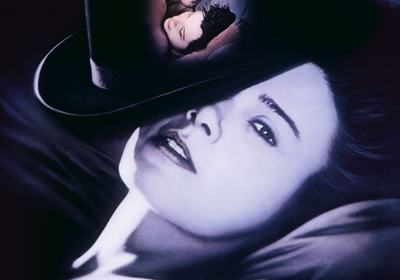
Philip Kaufman’s The Unbearable Lightness of Being (1988) after
Milan Kundera’s The Unbearable Lightness of Being (1984)
Who but Kundera interrupts a novel
for an extended excursus on kitsch?
He would insist, rush to tell us,
we are forgetting Denis Diderot’s Jacques the Fatalist
and all its interjections, its plot interruptions. It seems,
the eighteenth century invented the postmodern
before the modern. But here
in the tale that gave vehicle
for sexy film sequences and bowler hat
fetishes and cameras and limbs
and playful eyes, even amidst Russian
tanks rolling into Prague,
a course on kitsch,
not just any but
outright totalitarian kitsch,
a cast of mind without humor
everything must be taken quite seriously.
In our own time of twisted truths
and wild exaggeration, I’m diverted by kitsch
in the ordinary, kitchen table sense,
by proliferation one by one
of gold Oval Office doodads,
so many silly signals of abnormality,
and yet even the humorless totalitarian
is humorous
What good is a secret police that can’t keep its secrets?
Kundera’s narrator admits
I have been thinking about Tomas for many years
but without owning his own flesh, his own blood,
a narrator careful to refer to “S.” and “Z.”
to protect personages purely fictional
from the line of sight of the state.
He, himself without backstory, without name,
without body type or hair color,
though able to assure,
once more I see him the way he appeared to me
—yes, the narrator writes as novelist—
at the very beginning of the novel.
His characters, not born like people,
draw their breaths from
a situation, a sentence, a metaphor.
Still enough story for a young Daniel Day-Lewis,
a younger Juliette Binoche, and the others
to infuse with life until the last
frames phase to fog.

Carl Landauer, a visiting scholar with UC Berkeley’s Institute for South Asia Studies and contributing editor for Poetry Flash, taught history at Yale, Stanford, and McGill. His book of poems on film adaptations of literature, The Reel and the Paperback: Refracted Ekphrases, is forthcoming with Sagging Meniscus Press. His poems have appeared or will appear in the Kenyon Review, New American Writing, Exacting Clam, VerseVille, Poetry Flash, Santa Clara Review, Bangalore Review, Pembroke Magazine, Orange Blossom Review, Caveat Lector, Life and Legends, and the Mary McCarthy Society website, and his writing on cultural history has appeared in Beat Scene, Salmagundi, The American Scholar, and Renaissance Quarterly—as well as a critical analysis of Project 2025 published by Public Seminar.