

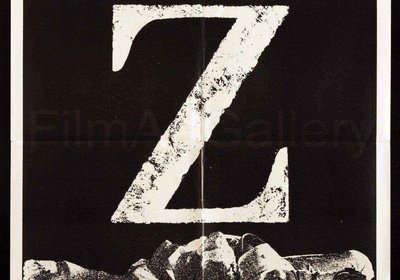
Costa-Gavras’s Z (1969) after
Vassilis Vassilikos’s Z (1966)
Just hearing the driving
Greek instrumental theme,
the pressing opening
was it one bouzouki
followed by a second in sequence?
returned me instantly
to my teenage rapture.
The film rushed in again
bringing me back to
an era marked by protest
in Morningside Heights and
on the Left Bank.
I didn’t know then
that the music of Mikis Theodorakis
was banned in Greece
under a specific order
Army Order no.13 they called it
drafted for a single composer,
or that music sheets were smuggled
across borders to be reworked
and sculpted for film.
The Z of novel and film
and we’re told the real Lambrakis
were stoic without hint of fear.
Yves Montand had an easy job.
Soon off the screen
the body was without memory
while others could not escape their
instinctive fear of turning into a photograph.
When the
body imprisoned in the train saw nothing,
we track the persistent paces of a
young prosecutor in dark-rimmed
glasses who finally comes to
interrogate each police commander
in military uniform in exact sequence
with ever-increasing rows of
theater ribbons, punctuated
by the IBM Selectric ball,
its rapid clatter as it churns to record
interrogation and indictment.
But witnesses disappear and
die in car crashes and fall
from windows. The junta
is in control.
Vassilikos told of a hero’s death
and an ill-fated inquest
but only Costa-Gavras
focuses on the pained eyes
of Irene Papas and drives
us forward with the rhythms of
Theodorakis.

Carl Landauer, a visiting scholar with UC Berkeley’s Institute for South Asia Studies and contributing editor for Poetry Flash, taught history at Yale, Stanford, and McGill. His book of poems on film adaptations of literature, The Reel and the Paperback: Refracted Ekphrases, is forthcoming with Sagging Meniscus Press. His poems have appeared or will appear in the Kenyon Review, New American Writing, Exacting Clam, VerseVille, Poetry Flash, Santa Clara Review, Bangalore Review, Pembroke Magazine, Orange Blossom Review, Caveat Lector, Life and Legends, and the Mary McCarthy Society website, and his writing on cultural history has appeared in Beat Scene, Salmagundi, The American Scholar, and Renaissance Quarterly—as well as a critical analysis of Project 2025 published by Public Seminar.