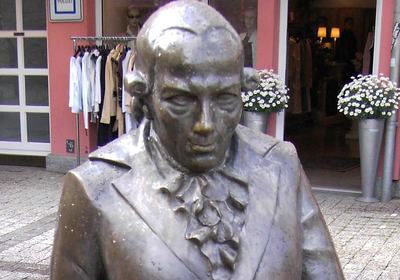
The delight I have in reading Lichtenberg is in how he has such a bounty of pithy, concise, penetrating and wry observations about human character, emotion, hypocrisies and ironies, and much of this can feel contemporary. There are observations of his that would not be peculiar in what are commonly perceived as ‘liberal’, ‘progressive’ environments, at least with regards to judgement of history (Lichtenberg mocks missionaries, phrenology, “the American who first discovered Columbus made a bad discovery”, etc.).
This isn’t an unfamiliar sentiment when reading various thinkers from the Enlightenment, from Diderot to Voltaire, but what’s so pleasant about Lichtenberg is how he doesn’t fit within a defined, neat conceptual box, where there is less of a solid idea of taxonomically defining his position or ‘school’, and unfortunately the wish to rigidly catalogue people and ideas, as if they were measurable and distinct qualities in chemistry, is still common. Lichtenberg has a great fluidity to him, much the same as with my favourite thinkers (Montaigne especially).
One can see with a few of Lichtenberg’s aphorisms why Wittgenstein was so admiring.
“Our false philosophy is incorporated in our entire language; we can, so to speak, not reason without reasoning falsely. We fail to consider that speaking, regardless of what, is a philosophy… Our whole philosophy is rectification of colloquial linguistic usage, thus rectification of a philosophy, and indeed of the most universal and general…”
Indeed, it is arguable, however obtusely, that there are sayings of Lichtenberg that get to the core of what Wittgenstein said (and with more charm), so much so that if one is a very lazy reader (as most of us are), I could recommend to skip Wittgensteinian essentials and go to the source of the river, so to speak. We don’t, necessarily, have to read Wittgenstein if we find it a chore. There are illuminations of the same sort, or their past gestations, that make for more entertaining (or less difficult) reading, and that are just as insightful. This isn’t a course I recommend to a serious thinker (or to someone who wants to be), but then I don’t think we need to be “serious thinkers”, or at least we don’t all have to be rigorous scholars, and it isn’t the greatest thing in the world to be “well read”. Lichtenberg reminds us, wittily, how enough people read (and read excessively) in order that they don’t have to think, and they get into the habit of learning to read before they learn how to think, so that what they think is, simply, what they’ve read; and often what they’ve read most recently. For all our just worries about illiteracy, we still read to prevent us from needing to think for ourselves, and the most widely read scholars are not always the most intuitive, or leant to making novel discoveries. Reading too much can create a “learned barbarism”. Illiteracy is present in those who read so much as what they are reading is superficial or, rudely, of low quality. We are not so speedily reading what is dense, that requires one to sit down, pause, reflect and make up their own mind. We instead rush through stuff that’s very easy to read, or comprehend, very quickly. We might only consume such a huge quantity of material if the material doesn’t require much digestion.
Lichtenberg expressed his vulnerabilities, much as his predecessors Montaigne and La Rochefoucauld do so well. They admit their follies not to take glory in their own misfortune but to point out, simply, the fragility of memory, the body and the mind, and our capacity to be reasonable. Many learned, brilliant thinkers today and throughout history are reluctant to admit, or are incapable of noting, our fragilities; hence their arrogance and denials of life and death.
It can be depressing to think how forward Lichtenberg was, and how many other thinkers from the Renaissance to the Enlightenment were in many ways more ‘progressive’ than modern minds. Enlightenment thinkers, individually, and the practical legacies of Enlightenment thought are different. Without the Enlightenment we wouldn’t have the technology and so, inadvertently or not, the terror of modern industry and 20th century totalitarianisms, but it is beyond silly to blame Diderot for that. When we note how biting and critical these thinkers were, we can look ridiculous and small in comparison, and it is not easy to say we have progressed so far, at least in terms of higher knowledge or self-reflection. Self-reflection is something we fetishise today and yet we are still very bad at it. We have a kind of temporal, chronological prejudice where we believe, as time goes on, that we naturally accumulate more knowledge, and our mass accumulation of information somehow means the accumulation of knowledge, and the presence of more information by itself means, apparently, our moral and intellectual superiority to all from the past. Our abundance of information, and surplus technology, makes us reluctant to admit our failings or our ready capacity to (intellectually, morally, politically, spiritually, societally) degenerate. We still believe industrial, technological progress is the same as moral and political progress; we believe this even when authoritarianism grows from the decomposition of democratic norms. The raw advance in the efficiency and function of machinery allows us to see progress as a natural teleology, even when the products we buy are getting worse. Beyond machinery, it is difficult to have hope even in the morally correct. Enough who announce themselves as morally elevated (and by extension politically elevated, even when their morality doesn’t penetrate political action), whether they are or not, do so with an entirely self-destructive condescension and patronising glare. On the furthest boundaries of the left, of any angle in the so-called centre, righteous moral superiority pervades; and it matters little, even if you are correct, if you are useless and have no friends. This superiority is extended to reach over the past, while the past is drawn as a cartoon. The sins of the past are paraded as if they are shiny new discoveries, as if we didn’t already know the past produced terror. It is obvious that we were morally impoverished in the past, so to make a show out of it is to suggest how much better we are today. See the fruits of industry and think, are we in a position to say we are truly intellectually and morally advanced? By some measures surely, yes, but much as one who parades their piety isn’t the best reflection of the possible good of religion, parading moral superiority means it is likely we might be insecure; so about what?
I have my own prejudice against the intuition that historical progress is natural and inevitable. It is enough that it is a common intuition for me to be suspicious. I think in the next few years, we will see a significant regression of not just the hard-won rights and liberties of minorities and the structurally disadvantaged, but a regression in so many institutions we take for granted, the rule of law; victims of our own arson.
Our best thinkers are never our heralds. Our rulers are occasionally intelligent but are almost never the best, most ingenious, best read, most erudite or prudent. This is so obvious that to say so looks banal or tedious. “Is it not strange that you can attain to the highest position of honour in the world without passing an examination demanded of any town physician?” The best analysis of human drama is never from the king’s chamber. Scholars are always beneath rulers, the king’s weakly advisor, and this impoverishment in the political positions of our best minds, in all ages, could persuade us, if we are not careful, of a rude sort of might is right brutishness, where the sword is mightier than the pen, where crude displays of physical strength and savagery work better than erudition, where the prevailing ideology will be (or is) an indulgent, narcissistic electoral monarchism, where the people accept their slavishness to a callous executive and reject anything of process and balance, lest such things interfere with the whims of a wrathful king. If we are unfair, we might say we get what we deserve; though I’d prefer to be fair and refute all of this.
Hope for the future is hard to make a case for, especially as we are caught in such an anxious, unsure historical moment (as much as we shouldn’t forget all of history was anxious, and never so sure, we still have particular worries). We can take perverse comfort in a banal fact, that historically we’ve been through a lot worse, and that we are moving from a period of (relative) prosperity into something else, and coming to terms with this rupture requires grieving. Compared to general history, our recent past was relatively fair, or instead less terrible than most of history. Yes, despite my above protestations at our hubris, we are better in many ways. I wouldn’t be alive in any other age. We are moving into a time that won’t be as prosperous, but the much further future is less predictable. Take perverse comfort again in the fact that most economists are terrible psychics, and the future is always unpredictable. Frankly, nobody is very good at all at clairvoyance. Beyond our more immediately predictable tragedies, from the climate to democratic failure, the future doesn’t have to be sour. It is a mistake to think the worst times in the past were a sure bet, as if they couldn’t have gone differently, and the same applies forwards. We have been through much worse periods of hopelessness and despair. It is of course a touch insulting to say this to people, to ourselves, when we are in the middle of the mess, as if we shouldn’t worry because others had it worse. No. This feels crass, but if we are going to remain dour then what respite can we take? There is something. I have my immediate personal worries, which include my poor health and death, so why should it be that I concern myself with the scale of history? True, I am in a better position than most to ignore it and live a quiet life in bed. Why add hopelessness upon hopelessness? Well, I don’t like to be alone, and I have no power or responsibilities, so I take notice of the world as if I can arbitrate its disputes and solve its conundrums, if only for my own amusement. Feeling connected to others is better than nihilistic solipsism, and short of having a gaggle of friends by my bedside, I can converse with Lichtenberg through his Waste Books, I can make grand, while still ambiguous and fickle judgements on life and history. I can feel superior to the superior by deriding their superiority. I can at least say I question myself more.
“One’s first step in wisdom is to question everything—and one’s last is to come to terms with everything.”

Jake Goldsmith is a writer with cystic fibrosis and the founder of The Barbellion Prize, a book prize for ill and disabled authors. He is the author of the memoir Neither Weak Nor Obtuse and the essay collection In Hospital Environments.