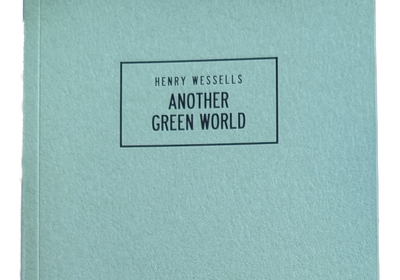
Another Green World
Henry Wessells
Zagava, Jun 2025
Henry Wessells’s Another Green World opens in a swamp. Primordial, unknown, dangerous, and, of course, green (always growing). This swamp is the central metaphor for these stories, the idea of a secret ancient knowledge that swallows and, at the same time, is itself swallowed up by Man.
These pages contain echoes of Jeff VanderMeer’s Annihilation and His Name Was Death by Rafael Bernal, and even stronger reverberations of Lovecraft. Wessells creates a book on modern issues that has a very erudite voice which sounds like it comes from the beginning of the previous century. It is a scholar speaking to you about the esoteric but with masterful, elegant prose. Every story lets the reader in on some secret knowledge. What is most enjoyable is this sense of excitement about seeing into the unknown as well as its danger inherent within the ‘knowing’. Through these unveilings, we walk along the precipice between this world and another, always just a slight misstep or breath of wind away from falling off.
As these stories reveal secret knowledge, they also enforce the idea that greed ultimately leads to destruction. In the first story, an academic abandons the modern world to live in a shifting nature, the ground alternately water or earth under his feet. He seeks to understand a more universal truth but is helpless as he watches the modern world poison the swamp, ruining the heart of everything unknown.
Another entry is about Don Webb’s Rhinestone Manifesto, something Wessells refers to as a work of ‘critical fiction’. There are several critical fictions throughout this collection and they combine criticism and fiction, utilizing real elements (ex. there was a man named Don Webb who wrote a story with the aforementioned title) but combining them with imagined events to create a very surreal, slippery world where the line for reality keeps shifting. In this particular critical fiction, a book is mailed to Don about a zombie queen from French Guinea. An edited version of this ‘diary’ was published but ended abruptly. This one he receives in the mail continues the story and reveals the process of becoming a zombie. These critical fictions which are intermingled through the book were very fun, both in their mystery and their elucidations.
This book will appeal to lovers of the occult. Wessells does not pare down his intellectualism but still manages to produce very beautiful prose. He ties together words in ways that unburden them from the heaviness of cerebral language. Each new narrative becomes a modern legend. They are concerned about the separation of people from the secrets of nature by the increasingly digital, mechanized world we’re building. In these pages, Wessells wrestles with topics like genetic modifications, industrial sprawl, and environmental collapse. It is a uniquely horrible foreboding that we live with in the 21st century; one that is rooted in both the Earth (nature/birth) and its manipulation and ultimate destruction (institutions/death). A reality where there is real peril in asking ‘what’s next?’
“A seed sprouting awareness in arid silicate soil, a molecular green language assembling momentary knowledge from stored potential. Language awaiting germination with encoded dreams of eating asphalt and automobiles concrete and polyvinyl chloride, fiberglass and steel. In the seedsplit greenness of now, there is no meaning to past and future, center and periphery, subject and object. Sprouting tendrils of a green millennium released from dream into sunshine and possibility. . . . Seeds dispersed to the winds, eaten by birds, crunch and smear onto passing cars in slamdance methodology of language awaiting circumstance.”

Jesi Bender is an artist from Upstate New York. She is the author of the novels Rhododendron (forthcoming 2027), Child of Light, and The Book of the Last Word; the plays Crux and Kinderkrankenhaus; and the poetry collection Dangerous Women. Her shorter writing has appeared in FENCE, Denver Quarterly, Sleepingfish, and others. www.jesibender.com