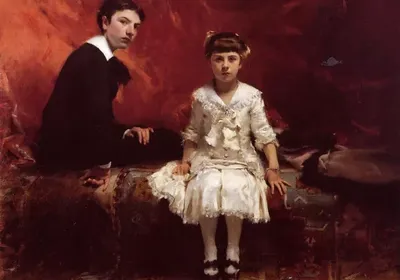
President Garfield had been shot by a lawyer and many were blaming the heat. There were fires in the Central Park and scuffles over ice. And yet, despite these conditions, the Pailleron children were made to stay indoors. The afternoon air in the upstairs room where they waited lay on them as heavily as censure. With his jacket buttoned, and his necktie pulled tight, Edward could barely breathe. He was worried his sister might faint. Every time Marie asked, ‘Is he coming?’ her voice was smaller, until after an hour it was only a squeak. Although Edward kept saying, ‘Yes, he’ll come,’ her brother had no idea if the famous painter would arrive.
At four o’clock, two hours late, Mr. Sargent appeared.
‘Hello children,’ he said. ‘Are you ready to start?’
They nodded, not trusting their voices. His tardiness made them question his identity. While the tall, bearded man before them matched his likeness in the newspaper, at that moment both children were too ill-disposed to grant him recognition. They inspected his hands for flecks of paint, proof he was the artist who had made the picture of a mystery woman whose shoulders were frighteningly bare. It was a painting their father had described as ‘a Frenchified scandal’ but which their mother adored.
The children’s scepticism grew as they noted that Mr. Sargent carried neither easel nor canvas; no brushes poked from his pockets. He could have been a junior clerk from their father’s bank.
They were only slightly reassured when the painter gave them instructions.
‘Edward, why don’t you sit by your sister? Closer. There. Now both of you look at me. Marie, sit a little straighter. Edward, lift your head. That’s good. Stay like that. I think I can begin.’
But Mr. Sargent didn’t. He reached in his pocket, produced a slim cigar, ignited it, then sat down. For the next fifteen minutes all he did was smoke while regarding the children as if they were mannequins in a store window. When his cigar was finished, Mr. Sargent stood.
‘That’s enough for today,’ he said.

The heat continued. Horses died. Mr. Sargent arrived for their sittings each morning between nine and nine-thirty. During their allotted hour he spent more time smoking than in trying to capture their likenesses. After six sessions the Pailleron children were barely on the canvas. Edward was a black circle; Marie was even less.
Just before their seventh session Marie had an outburst.
‘I hate him,’ she said. ‘I hate his hairy face. I hate his little cigars.’
‘They smell like old boots. And he loves the sound of his voice.’
‘He sounds like a frog. We’re in prison,’ she said and Edward could only nod.
But still they sat for another hour in which little was done. At the end of their session Mr. Sargent apologised that he could not come the following day because he had to escort his aunt to the docks.
‘A dear woman. But a trifle nervous on boats. I’m sure you’ll find pleasurable ways to occupy yourselves in my absence.’
They did their best to enjoy this day of liberty. While Marie and her mother inspected new dresses from Paris, Edward accompanied his father to the bank. The two of them sat in the back of the carriage while Jenkins steered around drays, tramcars and pedestrians made careless by the heat. Edward listened with great interest to his father’s explanation of the hierarchy of the bank, especially the crucial role of Acquisitions, since this was where his father felt that Edward’s banking career should begin. Edward was so engrossed that he barely registered the life of the streets through which they passed. Men were already at work, some in shirt-sleeves, most stripped to the waist, as they hammered barrels, laid sidewalk, hoisted crates, while cursing the conditions. He did, however, notice two women hoisting placards on which was written ‘Our Republic Needs Wives and Mothers’. Though exposed to the sun, and coughing from dust, they kept their placards high.
The bank occupied most of a Midtown block. From the vault’s cold chamber they ascended to the hush of the archives, then sampled the anger of the mailroom, the chatter of the secretarial pool, the held breath of the accounting hall. Some of the clerks were little older than Edward yet were so hunched and pale it was as if they never left their desks.
At lunch father and son ate lobster all the way from Maine while enjoying a panorama that seemed to let them see as far.
‘Take a good look,’ said Mr. Pailleron, as if the view itself was a lesson. While he cracked a tail, Edward’s gaze explored the horizon, looking left, then right, then left again, as if searching for a feature that had been removed.
On the drive home a slight breeze made Jenkins whistle until Mr. Pailleron rapped on the partition. Neither he nor Edward spoke, one from indigestion—always a hazard with crustaceans—the other because he was considering all he’d seen. No longer was the bank the mysterious place that stopped his father taking him boating or to the World’s Fair. Now that edifice was peopled, had desks, stairs, a huge brass clock that marked the changing hour. Now he knew what to expect. For the next fifty years he would be told when to arrive, when to leave, what he should wear, how he should sit, how to style his hair.
It is understandable for a young man with means and intelligence, who hoped for more exotic horizons (so much further than Maine!), to balk on the threshold of such a career. Although Edward had never expressed a preference for any other occupation, he was sure his father had never asked him whether he wanted to enter the bank.
By the time they were home Edward had decided that the better route would be to continue with his studies, preferably at Harvard, then travel in Europe for several years. Only after this would he be willing to select a profession.
That night Edward lay awake trying to convince himself that his father would agree to his plan. Though it would be unfair to call his father capricious, Edward could recall occasions when he had refused perfectly reasonable requests with such abruptness that he could only conclude his father believed him too young to be capable of serious thought. It was certainly true that when Mr. Pailleron made a pronouncement, he rarely changed his mind. Only the intercession of Edward’s mother could persuade him in such cases. She had only to whisper a few words to his father and he’d reconsider firing the cook or cancelling their trip to Boston. It was quite uncanny. Such was the power of marriage.
Their next three sittings for Mr. Sargent were torture. Marie had to wear a green velvet scarf because the painter said it was that or she change her eyes. Edward’s situation was worse. Although finches were dropping from the sky, their little hearts heat-broken, Mr. Sargent made him wear a winter coat. When, after an hour, Edward asked to remove it, the painter was so aghast he raised a hand as if to ward off evil.
‘But my dear boy, the coat is the picture.’
As Edward sweated he thought of the gentler climate in Cambridge. He walked in the cool of Harvard’s library, his fingers tracing spines. He could not conceive of any greater freedom a man might be granted.
Their twentieth sitting took place on the hottest day of that year. Their sweat stung like bees. Marie fidgeted so much Mr. Sargent sighed.
‘I did not choose the season,’ he said, then gently shook his head.
This rebuke made Marie sulk for the rest of the day. Though she was a patient, forgiving daughter, there were limits to what she could endure. At dinner she refused to eat and sat with folded arms. When her father said, ‘Don’t waste this food,’ she made no reply.
When the first course was cleared away her mother said, ‘If you don’t want to eat, you can go to your room. I’ll take you there myself.’
Edward and his father remained at the table. It was clearly an opportunity to raise the subject of his future, but he suspected that his sister’s protest had put his father in an ill-humour. He was proved correct when his father began to bemoan the squalls of the feminine temperament. Edward would have liked to counter with the observation that, had he been a few years younger, he might have behaved the same as his sister, but feared this mild objection would further provoke his father. He sat and silently listened as his father went on to take aim at the damned suffragettes for eroding the family and weakening the nation. Under such circumstances, it was no wonder that a jumped up clerk had shot the President.
As soon as Edward was able to escape he went to his sister’s room. He found Marie lying face down on her bed. He could see she had been crying.
‘It’s so unfair,’ she said. ‘They’re treating us like criminals and all for a stupid picture they only want because he did one for the Van Rensselaers. Daddy doesn’t even like art!’
‘He’s a philistine. He says photography has made painting obsolete.’
‘Let’s run away.’
‘We wouldn’t get far. And we’d melt.’
‘True,’ she said, then laughed. She struck the bed with her fist. ‘It just makes me so angry. I don’t want to sit there in silence while some stupid man stares at me like I’m a jug. I’ll be twenty by the time he’s finished.’
She began to cry again.
‘Look,’ he said, ‘I know this is awful. But you just have to be patient. When you’re older you’ll be free. Men like father can’t stop it. You can be the New Woman,’ he said and smiled.
‘Yes,’ she said. ‘I can ride a bicycle as well as anyone. And you’ll help me with the rest, won’t you?’
‘Of course.’
He could picture her at Vassar or Wellesley. She’d be brilliant. She’d choose her own profession. Her own husband. He'd be so proud of her.
Brother and sister embraced, then Edward retired to his room. As he prepared for bed he began to consider how he might help Marie in the years ahead. He imagined himself defending his sister’s choices, vouching for her ability, while his father listened in stony silence. It was then that Edward foresaw the way his father would oppose his own ambitions.
‘So you want to be a thinker?’ he’d say then leave the word suspended. ‘If you said you wanted to be a carpenter, I’d ask to see a chair or table. If you wanted to be a baker, I’d want to taste your bread. So tell me—what have you thought?’
Edward knew he could not meet his father’s objections solely with arguments about the virtues of scholarship. It was no good constructing a tower composed of lofty sentiments—he would need the scaffolding of proof. He would need to present his thoughts.
Despite the urgency of the matter, Edward did not rush to composition. Only after three days of reflection did he embark on An Enquiry Into Natural Justice. His essay began well with a quote from Horace but wobbled when he tried to distinguish between Divine Justice and that which Man contrived. He steadied it with thoughts from Confucius and Emerson, but after several hours he realised that the leaning tower he’d constructed was nothing but a heap of notions borrowed from great men. His father would only have to huff and puff to make it all come down.
After thirty sittings Mr. Sargent rejected their chaise longue.
‘It’s much too red. And much too curved. We’ll have to start again.’
On hearing this Marie went to her room and snapped all her pencils. She spent the afternoon lying on the spurned chaise longue with a cold compress on her forehead, while muttering and clenching her fists. At dinner she barely ate.
The next day her condition worsened. She complained of stomach pains and a ringing in her ears. That afternoon Edward found streaks of blood in the toilet bowl in the bathroom they shared. He was so concerned her rage had caused a rupture he sought his mother out.
He found her in the hallway. She listened calmly to Edward’s fears for his sister, then said, ‘Marie is becoming a woman. She is changing, just as you changed when you grew a moustache. But for women, this can be difficult, sometimes painful.’
He nodded, and wanted to turn away, but his mother hadn’t finished. She put a hand on his shoulder.
‘And the blood is part of that. Every woman has this happen once a month until she is old. It happens to me, it happens to your sister, it will happen to your wife.’
He blushed, but with the matter explained, he told his mother he needed new ties. He wondered aloud whether he might dare to wear an Ascot.
‘Why not?’ she said. ‘You should experiment.’
Though this conversation assuaged his fears for his sister, it also engendered many questions about female physiology. He went to consult his father’s library but was disappointed to find few works that dealt with the subject of menses. The encyclopaedia had more to say about the bodies of earthworms than the human female.
Only Pliny met the subject head on. Edward read that contact with the monthly flux of women turns new wine sour, makes crops wither, dries seeds in gardens, causes the fruit of trees to fall off, dims the bright surface of mirrors, dulls the edge of steel and the gleam of ivory. It kills bees, rusts iron and bronze, and causes a horrible smell to fill the air. Dogs who taste the blood become mad, and their bite poisonous.
While Edward did not entirely doubt these assertions—all prohibitions have their basis—he was frustrated by the lack of a more contemporary account. This dearth of curiosity about the inner workings of half the human race was very puzzling. That night, as he surrendered to sleep, he pictured the women of the city in stores, in carriages, on the boulevards, engaged in diverse occupations, making purchases and conversation, advising customers, instructing children, holding placards high. All of them, whether genteel or poor, were in possession of a mystery he wanted to solve.
On Sunday they listened to Father Molloy read from the Book of Jeremiah. The elderly priest’s voice wavered as his hands grasped the pulpit.
‘When He utters His voice, there is a tumult of waters in the heavens. He causes the clouds to ascend from the end of the earth. He makes lightning for the rain and brings out the wind from His storehouses.’
Father Molloy paused to wipe his brow, then lifted his eyes from the page.
‘Clouds and darkness are round about Him! His pavilion is dark waters and thick clouds of the skies! Justice and judgment are the establishment of His throne! Mercy and truth shall go before His face!’
The congregation sighed as if a cool breeze had blown through the church.
Marie clutched her brother’s elbow and whispered, ‘I just had a wonderful idea.’
‘What is it?’
‘You’ll see,’ she hissed and then Father Molloy asked them to bow their heads for their President whose wounds had still not healed.
The next day there was such a deluge Mr. Sargent could not reach their home. Edward spent the morning trying to emancipate thoughts from the marsh of his mind but they preferred the ooze. After a painfully frustrated hour he turned to Cicero for inspiration, and then read profitably until he became aware of a disturbance downstairs. Even through the thick oak of the library door he could hear raised voices, the slap of palms conjoining. He stood and went to the landing and from there gazed down and saw the household staff applauding while Marie turned cartwheels. For a moment he was baffled. Marie had always been clumsy and yet now she was graceful as an acrobat. He was equally surprised by the force of the staff’s approval. Though the cook and the maids were usually so self-effacing that they were little more than shadows, now they seemed to have no qualms about being heard. His sister’s antics were as delightful to them as the arrival of a visitor they had been expecting for years.
Next day the city woke to clearer skies. To console himself for the imminent arrival of Mr. Sargent, Edward took an early stroll but after three blocks the heavens opened and Manhattan became an Atlantis. Edward walked briskly for a few steps, then permitted himself to run. He soon found it fun to splash from puddle to puddle because he couldn’t get more wet. In this gay manner he made his way quickly home. Once dry, he felt something heave from his mental murk. The cancellation of their session with Mr. Sargent allowed him to return to the library. After an hour of great effort he had fashioned three sentences that seemed like his own. For the first time he believed that he could produce a text that would convince his father of his talents. All he needed was time.
At suppertime the rain had yet to cease. Before entering the dining room Edward paused at a mirror to adjust his new necktie—though not an Ascot, he thought its blue stripes just as bold. Thus engaged he heard his mother say, ‘I’m very proud of you Marie. It’s remarkable at your age. But my dear, you’ve made your point.’
‘I’m not trying to make a point,’ said Marie. ‘I just want him to stop.’
‘But he’s not going to,’ said her mother firmly. ‘The painting must be finished.’
He heard his sister sigh, then the dinner bell rang once more. He entered the dining room and found his mother and sister together under the painting of Titania and Oberon. Both offered him a stare that made something flutter in his head. He could not recall what they had just said but he was sure it was nothing important.
His father entered, then as a family they sat. There was turtle soup; some fine cutlets; Mr. Pailleron passed a few remarks to Edward about a recent meeting of the Acquisitions board. Edward nodded and tried to keep eating, but the meat was like glue in his mouth. His teeth made no progress; he couldn’t swallow; he wanted to scream. But mercifully Edward’s father silenced himself. He held up a hand.
‘Listen,’ he said, and they obeyed. The rain had ceased as suddenly as if someone had turned a tap.
‘I suppose we must thank God,’ said Marie and smiled. ‘Now may I have more peas?’
The next evening brought Edward the opportunity he had been waiting for. After an excellent dinner of roast guinea fowl his father was in good humour. They listened to Mrs. Pailleron recite a poem by Helen Hunt Jackson and her performance obviously pleased her husband. When she went to arrange refreshments Mr. Pailleron cleared his throat and looked at his son with a look that broadcast both benevolence and the two glasses of port he had consumed.
‘Did you enjoy that my boy?’
‘Very much.’
‘Your mother has a wonderful voice. She can make even that silly poem sound like music.’
He looked at Edward a moment longer, perhaps sensing, with parental telepathy, there was something his boy wanted to say. But none of the opening remarks Edward had prepared seemed apposite. If he said the wrong thing, or the right thing but in the wrong way, his father would refuse him. And while Mr. Sargent was willing to clean his canvas, admit his errors, his father’s decision would be final. There would be no Harvard, no library, no bookcases for shelter.
Edward sat silently until his sense of cowardice drove him from the room. He dragged his shame upstairs. As he passed Marie’s room he saw a black cat sitting on her bed. The cat noticed him, then looked away, intent on polishing its fur. In perplexity at its presence he sought his mother who smiled and said, ‘Isn’t she fine? She found your sister yesterday.’
They made no progress in their fortieth session with Mr. Sargent. When Edward and the painter entered the studio Marie’s cat—which she refused to name—was sitting in her place. Mr. Sargent regarded the creature for a moment, then said, ‘A fine animal. Look at her eyes! I’d be glad to substitute her for Marie, but I suspect your parents would prefer your sister in the portrait. Would you mind locating her?’
Edward spent an hour searching the kitchen, the dining room, the library, his father’s study, even in the garden, but without success. Marie was playing hide and seek, which was typical, yet irresponsible, and might have grave consequences if Mr. Sargent complained to his parents. In his father’s eyes Edward would be just as guilty, perhaps even more so: his father was always telling him to be his sister’s keeper.
He went back to the kitchen, then upstairs to the library, then back downstairs to a cupboard he’d already looked in. And yet for all his seeking, his sister was still hidden from him.
When he confessed his failure to Mr. Sargent, who was enjoying his second cup of coffee by the fireplace, the painter didn’t seem upset. He responded to Edward’s profuse apologies by saying, ‘Your sister has finally escaped!’
Seeing that Edward was distressed, he ventured that they could still make progress, especially on Edward’s legs, which he confessed were causing him difficulty. 'I don’t want them to say you have rickets,’ he said.
Mr. Sargent was first to enter the studio; Edward heard his intake of breath.
‘Look who’s here,’ he said. Marie was sitting in her usual place, kicking her heels on the floor.
‘You’ve played a trick on us,’ said Mr. Sargent.
‘I don’t know what you mean,’ she replied. ‘I’ve been here all the time.’
‘Bravo!’ he said. ‘And I respect your efforts. I’ve no doubt you could ensure that our painting will never be finished. But let me ask you this. Are there not some other grander goals you’d rather be pursuing?’
‘Thank you. I promise I will work as quickly as I am able if you allow me to. But the choice is entirely yours.’
There was a long pause before she said, ‘Very well. I agree.’
‘Good,’ he said. They shook hands and Edward found it hard not to laugh at the painter’s credulity. A grown man tricked by a little girl! He was still smiling when Mr. Sargent rearranged his subjects. Henceforth Marie was to be the centre of the composition.
The following morning Mr. Sargent asked to see all of Edward and Marie’s wardrobes. Once the servants had laid the clothes out he paced back and forth, occasionally stopping to examine a collar or sleeve, yet could not decide.
Edward pointed to his English brown suit. ‘What about this?’
‘Impossible. It makes you look like a tree.’
The three of them stood in silence. Edward considered his ties. All of them, even the new ones, belonged round a schoolboy’s neck.
Marie stepped forward and touched a frilly cream dress with a scalloped collar. ‘This one for me,’ she said. ‘And that,’—she poked a black velvet jacket—‘is for my brother.’
Mr. Sargent frowned as he looked at the clothes, then back at her.
‘Dear girl, you may be right,’ he said. ‘We may as well find out. If you’d be kind enough to change, I’ll see you in the studio.’
When he’d left the room, Edward whispered, ‘Why did you help him? I thought you hated this.’
‘Oh Edward,’ she said. ‘I hope you’ll be happy. But that’s really up to you.’
‘What on earth do you mean?’ he said. Because he had not confided his plans to her. He couldn’t risk her blurting something at the dinner table.
Instead of replying Marie turned, then brought one hand behind her back. ‘Will you unbutton me?’
‘Not until you explain.’
‘Actually I can manage,’ she said, and then her dress fell from her shoulder. He looked away quickly, why he didn’t know: she was only his sister.
But though she was younger, Edward had to concede that she already had the feminine eye. Mr. Sargent declared himself pleased with their outfits.
‘Very good,’ he said. ‘We’re making progress.’
Marie sighed. ‘How long?’
‘No more than three weeks.’
For a moment Marie seemed to pulse with impatience. Then she mastered herself.
‘That’s acceptable,’ she said. ‘But no more.’
After supper Mr. Pailleron called Edward into his study. He lit a Monte Cristo, then said he had good news.
‘I’ve been talking to the other directors and they’ve agreed.’
‘About what?’
‘Your position. Of course you’ll be very junior, but only for the first three years. You’ll start as soon as Mr. Sargent has finished with you.’
Edward’s unfinished essay seemed a poor riposte to his father’s certainty that he was acting in his son’s best interests. Only when the essay was complete, and his talent obvious, might his father reconsider. But to finish it he’d need at least a month. The painting must be delayed.
He concocted a plan both brilliant and simple. Mr. Sargent, as a well-travelled man, must have many fascinating anecdotes about the places and people he had encountered. If these tales could be elicited, if he could be distracted, a great deal of time might be squandered.
At first Edward had little success. About Boston Mr. Sargent would only say that its hotels had such thin walls they seemed designed for scandal. On the subject of Italy, where he had spent part of his youth, he was more forthcoming. With lifted brush he spoke of the light in Florence, how it made the place seem like many different cities during a single day.
‘She’s anything you want her to be,’ he said, and was about to elaborate when Marie cleared her throat.
‘Mr. Sargent, your brush has gone dry.’
‘Don’t interrupt,’ said her brother.
Marie shrugged. ‘Please look.’
Mr. Sargent did as instructed. ‘No, she’s right,’ he said. ‘How, I don’t know. I have barely paused.’
‘I suppose the room is very warm,’ said Edward. ‘But please, Mr. Sargent, continue speaking about the sunset on the Arno.’
But his sister’s interruption had destroyed the moment. About Florence, and all other subjects, Mr. Sargent had nothing more to say. For the rest of the hour he painted with unusual concentration.
During their next session Edward prevailed upon Mr. Sargent to speak about Egypt. Though at first reluctant, the painter was soon persuaded. He rhapsodised about watching a queen being exhumed from where she had rested for thousands of years. She was so intact, and her colours so vibrant, she appeared ready to reassume her throne.
Almost half the session went by without him bringing brush to canvas, during which Marie said nothing. But as soon as Mr. Sargent left she pinched Edward on the arm so hard he reflexively raised his hand to strike her. For long afterward he remembered her expression. Her eyes were bright, her grin as wide as that of a jack-o’-lantern. He saw excitement; a flash of mockery; a total lack of fear.
Edward passed the next week anxiously. During the day he fretted over his essay; at night he dreamed of cold and silent places.
He was also concerned about his sister. She was maintaining a silence towards him that seemed to contain both accusation and threat.
When she knocked on Edward’s bedroom door one evening he was thus alarmed. He put down his novel and stood. He was surprised to see her smiling and offering him a steaming cup of cocoa. He was touched by her kindness—it was his favourite beverage—and then, on sipping the liquid, pleased by its richness.
‘What’s in this? It’s wonderful.’
‘I’m so glad you like it. It’s a special recipe Mother taught me.’
He thanked her again. She wished him goodnight. He finished the cup and then picked up his book. At first he was back with Daisy in Rome, but then he was in an earlier Rome, watching a chariot race, and the slaves were breaking their chains. Then it was morning and he was still in his clothes and somehow it was past ten. He hurried to the studio.
‘Here’s Rip Van Winkle,’ said Mr. Sargent without taking his gaze from the painting. On the canvas Edward saw his sister’s left hand, her fingers bent at the knuckles, pushing against the seat. His gaze rose to the face, which was of course his sister’s, but looked so unlike her that Edward doubted Mr. Sargent’s skills. It seemed to contain two faces, both that of a girl and a woman.
He was still groggy from sleep. If he could sit down, wake up further, it would all make sense. Yet when Edward went to take his place, Mr. Sargent held up his hand.
‘Don’t worry Rip, I won’t need you today. I’d prefer to concentrate on Marie. We’re making excellent progress. In fact, I think I won’t need you for the rest of the week.’
Milder weather brought the city outdoors. Whether strolling or being driven, the inhabitants were briefly united in their emancipation from the heat. Had Edward walked the five blocks to the Hudson he could have witnessed the crowd thronging the boulevard. Though they carried no banners, and chanted no slogans, as they surveyed the waters each of them, despite poverty or affliction, was able to believe that they formed part of a great enterprise that would grant them what they were owed. Eventually they would be given a job, an education, a vote.
From this riverside perambulation Edward might have drawn the necessary courage to present his case to his father. Yet while those people swung their arms, enjoyed hot nuts and pretzels, he remained at home in case Mr. Sargent required his presence in the studio. Once admitted he could surely tempt the painter into a digression. A clearer head might have counselled that he follow Marie’s example and remove his person. Yet Edward’s life had been so comfortable and unobstructed that the exercise of self-discipline was unfamiliar. Nor did he permit himself to name his true opponent, preferring instead to focus his ire on a sister he had not imagined could be so devious. He was going to teach her a lesson.
Mr. Sargent was surprised to find only Edward waiting in the studio next morning.
‘Has Marie flown the coop?’ he said and chuckled.
‘In a manner of speaking. She was taken suddenly ill. She’s in the hospital. It’s nothing serious, it’s happened before. She has quite a weak stomach.’
Mr. Sargent raised his eyebrows. ‘Well, please send her my kind regards and wishes for a speedy recovery.’
As the painter prepared his brushes, Edward asked about the Peloponnese. A sigh was his only reply. But where Greece failed, Turkey succeeded. As soon as Edward said ‘Bosphorus’, Mr. Sargent was transported. He spoke of the Hagia Sophia and the wonder of the dervishes who could turn so fast. But then he stopped himself mid-sentence and, without prompting, began to speak of Russia. He said the snow lay deep and in the monasteries no candles were needed because the icons glowed so bright.
‘And what’s most remarkable, Edward, is that the faces you see on the icons can still be seen in the villages. Christ is hard at work in the fields. The Virgin is at the well. It’s no wonder the Old Believers haven’t given up. Whatever changes occur in that troubled country, no matter how momentous, these old ways will endure for as long as they are needed. Something has to help people deal with injustice. Don’t you agree?’
Edward had been a staunch atheist for almost a year, so he had no ready reply. Only as Mr. Sargent was lifting his brush, did he manage to say, ‘And may I ask when you visited Russia?’
‘Oh, I’ve yet to have that pleasure.’
By the end of the session Edward’s left ear had been superbly rendered. Yet he was not disheartened by the painting’s progress. He had bought himself a few more days at only small cost to his sister. He sincerely regretted her pain and distress but hoped she might understand when she was older.
Yet his conscience was troubled. When he went to see his mother later that morning, although it was not to confess, he still hoped for absolution.
He found her deadheading the roses. She asked after Mr. Sargent, then said, ‘And you’ll be relieved to hear Marie’s condition is improving fast. She gave us quite a scare.’
‘That’s good news,’ he said and turned because he had to get to the library: he did not want Marie’s suffering to have been in vain.
His mother’s voice stopped him.
‘But I must confess I remain puzzled as to how Marie ended up consuming shellfish when none is permitted in our house. How do you think that occurred?’
Although her tone was without challenge, Edward felt the thumbs of her question.
‘Bad luck, I suppose. Maybe a box of shrimp was placed onto a box of tomatoes. Or maybe someone spilt a tray of clams. I’m sure such things are always happening in a market.’
He stopped himself from saying more. He waited. If she accused him, if she asked directly, he’d tell her everything.
She tilted her head up to the sun. ‘It may have been as you say. But if so it was a very unlikely event. I’m sure you’ll agree with me that nothing like that must ever happen again.’
‘Oh yes. I’m sure it won't.’
‘Alright,’ she said, then stooped to gather petals. Edward went to the library. He sat. He read. He tried to write but he kept seeing his sister clutching her stomach, her face full of pain, her look of disbelief. But she had done the same to him with that soporific cocoa. Now they were even. She could not be angry with him.
Marie returned from the hospital four days later. As soon as she entered the house and saw her brother at the foot of the stairs she launched herself at him. The room seemed to darken as she spoke in a guttural tongue. Her black hair was flowing and wild. She raised her hands in the air and in that moment Edward glimpsed the palimpsest Mr. Sargent had depicted, the two faces in one, the child and adult in a terrible, remarkable union that possessed all the beauty of lightning and yet its danger too.
‘Marie,’ said his mother and the girl lowered her arms. The sun crept back into the room. And though Edward had just taken a step towards understanding his sister, in his relief he quickly backed away. That strange moment had only been the conjunction of a little girl’s hysterics and a passing cloud.
‘Edward, you know I hate doctors,’ she said in a controlled voice. ‘You know I hate hospitals.’
‘Yes,’ he replied. ‘I’m sorry.’
‘I believe you are,’ she said. ‘But what does that change?’
He took an actual step back, fearing a pinch, or worse, but Marie was already heading upstairs. He had no chance to explain that he’d really had no choice. His future was at stake.
Edward did not see his sister over the weekend. Marie took her meals in her room and at all other times he was in the library, reading, writing, crossing out, speaking his sentences as if they were incantations. He worked hard, but did not panic. There would be between ten and fifteen sessions before Mr. Sargent was finished. He had at least two weeks left.
His sangfroid vanished on Monday as soon as he entered the studio. From the canvas his sister’s eyes stared through him, and the present moment, into some adult future. All that remained unpainted was Edward’s chin and a small section of rug. In a few days he would join his father on his morning commute. At the bank he’d be given his desk. There would be names to remember, procedures to follow. The door of his cage would close.
Edward backed out of the room. He was going to plead ill health, and if need be, make himself sick. Having poisoned his sister, it was only fair that he poisoned himself.
He was stopped by his name. When he showed his face to Mr. Sargent the painter offered none of his usual wit.
‘Is everything alright?’ he asked with clear concern.
Edward pointed at the canvas.
‘It wasn’t like that on Friday.’
‘No, it wasn’t. But sometimes a picture that seems far from finished becomes one that is. The change can happen in a moment, but it can also never happen.’
Edward nodded but did not understand. He did not look at Marie as he took his place. His collar bit his throat. He tried to relax but his breath came and went without his body deriving any benefit. And all the while Mr. Sargent’s brush made its awful stroking sound.
‘Mr. Sargent,’ he said, and Marie said, ‘Don’t.’
‘You were speaking about Russia. What do you know of the serfs now that they have been freed?’
In front of him Marie sighed then whispered his name three times.
‘You might as well ask what I know of the moon,’ replied Mr. Sargent without taking his eyes from the canvas. ‘Both are outside my orbit.’
Edward waited for him to continue, and when he did not, tried to ask about the Tsar. But his mouth refused to shape the words. A little whine emerged.
‘You will be quiet,’ Marie whispered. ‘You will let him finish.’
Edward had no idea what was happening, or how. His only hope was to destroy the painting. He was going to make Mr. Sargent start again.
He stood and leapt towards the easel.
But this was only a thought. His body had not moved. And that was when he finally realised that Pliny was right about his sister. And his mother too.
The following hour of terror did not feel like an eternity, just like several days. Edward could not even move his eyes. For the rest of his life the sight of the back of his sister’s neck would make him feel sick.
He heard horses clopping by, birds trilling in the trees. He pursued the sound of his breath as it entered then fled: anything but listen to the awful sound of brushstrokes. Yet these noises brought him no more consolation than the low, slow roll of the Atlantic gave to President Garfield as he succumbed to his wounds.
The hallway clock had just chimed eleven when Mr. Sargent sighed. He stood back. He considered.
‘Yes,’ he said. ‘Yes.’
And so, after eighty-three sittings, the portrait of the Pailleron children was complete. In the following years Mr. Sargent tried to avoid such commissions. He refused Lady Radnor by saying, ‘Ask me to paint your gates, your fences, your barns, which I should gladly do, but NOT THE HUMAN FACE.’
More than fifty years later Marie did not remember the experience fondly either. Though she believed she had won the contest with the painter, the memory of being posed like a doll was no less bitter. Yet she had had a rich life of her own choosing. She became a celebrated novelist and critic who wrote books about Musset and George Sand. She married, inherited a castle, and survived two World Wars. She filled her own canvas.
In her memoirs Marie did admit that after the final sitting she and Mr. Sargent briefly put aside their differences. Such was their mutual relief that both succumbed to an outburst of wildness. She shrieked as she tore the red backdrop. He laughingly beat the rug.
Edward took no part in this joyous destruction. Even though he had been freed from enchantment, he sat on his chair as rigidly as he would sit in the carriage with his father next day. The boy had learnt his place.

Nick Holdstock is the author of three novels, The Casualties (St Martins, 2015), Quarantine (Swift, 2022), and Porcupine (Sagging Meniscus, 2026), and a short story collection, The False River (Unthank, 2019). He has written three non-fiction books about China: The Tree That Bleeds (Luath, 2012), Chasing the Chinese Dream (IB Tauris, 2017) and China’s Forgotten People (Bloomsbury, 2019).