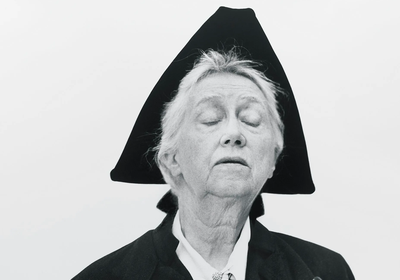
Have you ever read a poem by Marianne Moore? No? Well, you’re not alone.
“It is an oddity of American letters that no major poet is cherished more and read less than Marianne Moore (1887–1972).” Thus begins Grace Schulman’s introduction to The Poems of Marianne Moore (2003), the volume she edited for her late friend and mentor. Schulman goes on to explain, “Her readers know only part of what she wrote, for upwards of half of her poems, great ones among them, are not easily accessible.”
More than half a century after her death, Moore’s work is at least available, thanks to Schulman and others. Yet it remains too little known, especially when compared with the other makers of the revolution in twentieth-century poetry in our language: Yeats, Pound, Eliot, Williams, H.D., Stevens, Cummings, etc. This is doubly distressing in that there were not too many women in that charmed circle to begin with.
Moore’s poem “Poetry” is the perfect work with which to begin this new round of tributary essays and poems in the Clam. It was one of her more acclaimed poems during her lifetime and, as we shall see, created no little controversy when she abruptly and without warning excised almost all of it in her final decade. Keep reading, dear reader! All shall soon be revealed.
“Poetry” was first published in 1919 in the now long-forgotten journal Others, when Moore was a fiery young modernist of 32. She constantly revised everything right up to the end, including this poem. It took what appeared to be its final form years later. This is the version included in the volume edited by Schulman. It consists of five stanzas, each having six lines of varying lengths, except for the third stanza, which has only five lines. Like many of her poems it is a strange yet appealing mix of rhymes and syllabic verse. The first line of each stanza contains nineteen syllables, and the fourth and fifth lines rhyme, except in stanza three. The opening is quite famous and still jarring:
I, too, dislike it: there are things that are important beyond all this fiddle.
What? Is she kidding? Well, she obviously doesn’t dislike it enough to stop writing it. She’s saying several things here, I think. She’s acknowledging poetry’s lowly place as the least popular of literary genres, commercially and every other way. And she’s admitting she’s no great fan of the less-than-great verse pawned off on us by most poets most of the time. Which is why she immediately pivots in the rest of stanza one:
Reading it, however, with a perfect contempt for it, one discovers in
it, after all, a place for the genuine.
Hands that can grasp, eyes
that can dilate, hair that can rise
if it must, [. . .]
A place for the genuine you say, Ms. Moore? Can’t the whole thing be genuine, like in a Bach keyboard concerto? Interesting that she reserves the first rhyme in the poem for a description of the physical effects of real poetry on the reader. This is a clear callback to the observation by A.E. Housman that genuine poetry makes the hair on the back of your neck stand up.
One of the techniques that Moore uses to tie the five stanzas together is that she ends every stanza except the last with an enjambment, a run-on sentence that continues into the next stanza—even stanza three, the one with only five lines and no rhyme. Here’s how the end of stanza one leads into stanza two:
[. . .] these things are important not because a
high-sounding interpretation can be put upon them but because they are
useful.
She goes on to decry poems that “become so derivative as to become unintelligible.” Ponder that for a moment. To put it another way, only an original expression makes any sense. To ape another writer is to lose both the style and the content—the meaning—of one’s own work. The result, as she declares a couple of lines farther down, is that “we do not admire what / we cannot understand.” Largely because we recognize, even if only instinctively, that it contains nothing genuine.
Stanza three, the odd one out, mentions “the immovable critic twitching his skin like a horse that feels a flea.” I can’t help but believe that Moore may be referring to the well-known quatrain by Yeats, “To a Poet, who would have me Praise certain Bad Poets, Imitators of His and Mine,” which contains the memorable end couplet, “’Twere politic to do the like by these, / But was there ever dog that praised his fleas?”
Stanza three also mentions baseball for no apparent reason other than it is Moore’s favorite sport. Though when she refers to the baseball fan as “the statistician,” perhaps that is an observer comparable to the literary critic: someone who loves the game in passionate detail and knows exactly which games were great and why. The third stanza ends with an unidentified quote that once again is enjambed into stanza four thusly:
nor is it valid
to discriminate against “business documents and
school-books”; all these phenomena are important.
As it happens, the quote comes from the diary of twenty-three-year-old Leo Tolstoy, who himself is trying to define the realm of poetry, and opines that maybe “poetry is everything except business documents and school-books.” Well, I thought I was more or less literate and fairly well-read. There’s another illusion shattered! Of course I’ve read War and Peace and Anna Karenina and some of Tolstoy’s essays. But to expect the reader to know his youthful diaries . . . that makes Moore a very demanding poet, even though not deliberately difficult, never willfully obscure, in fact delightfully plainspoken. However, if you expect to engage in a dialogue with any of her poems, you had better be able to keep up your end of the conversation.
Her point remains significant, nonetheless. She refuses to exclude any subject from the purview of poetry, and for what it’s worth I must say I agree with her. Get back to your novels, little Leo! That Tolstoy quote is only the first quote in the poem. Before we jump to the next quote, Moore makes a caveat about the first quote and poetry being free to be about anything. She writes in stanza four: “One must make a distinction / however: when dragged into prominence by half poets, the result is not poetry.” Fair enough, but I can almost hear Ronald Reagan saying, “There you go again, Marianne! Another poet always trying to have everything both ways.” As lead counsel for the defense I say “Hey, that’s what we do, get over it, people.” The second and third quotes appear at the end of stanza four and the beginning of stanza five:
nor till the poets among us can be
“literalists of the imagination”—above
insolence and triviality and can present
for inspection, “imaginary gardens with real toads in them,” shall we have
it.
“Literalists of the imagination” alludes to a critique that Yeats made of William Blake in an essay. In essence, Yeats felt that Blake made no distinction between reality and the fruits of imagination. To Yeats, this was a mistake. Reality must be first and foremost with the writer, no matter how imaginatively portrayed, and no matter that the “millions of strange shadows” which Shakespeare saw inhabiting human consciousness are part of reality as well. Nothing is ever as simple as it first appears, especially in a great work of art.
Where does Moore fit in this argument? As Ghost President Reagan said earlier, she wants to have it both ways, hence the third and final quote about “imaginary gardens with real toads in them.” By far the most fascinating thing about this line is that she isn’t quoting anyone else. Here Marianne Moore is quoting Marianne Moore. And the quote doesn’t even come from another of her poems or an essay—she simply kept the line from an earlier version of this poem and put it in quotes, almost implying that it has come to have a life of its own and doesn’t really belong to her anymore. Notice, too, that this clever device also subtly puts her in the company of Tolstoy and Yeats where, frankly, Mr. Shankly, she quite deserves to be. And by doing so she deftly splits the difference between Blake and Yeats. That’s another vote for imagination and also another vote for the real. Can’t we let them peacefully coexist in our poetry? Must we have yet another either / or in our hopelessly divided world? “Poetry” provides both an answer and an example.
We are ready now for the exciting conclusion of stanza five, beginning with the rest of line two:
[. . .] In the meantime, if you demand on the one hand
the raw material of poetry in
all its rawness and
that which is on the other hand
genuine, you are interested in poetry.
At first glance, it must be admitted, this ending seems a bit anticlimactic. There are no fireworks, verbally or intellectually, none of the metaphors or similes from nature that spice up the rest of the poem. It juxtaposes “the raw material of poetry in / all its rawness” with the “genuine,” implying that they are not the same thing. Isn’t rawness genuine? Yes, indeed, in a way. Yet genuine poetry, whatever rawness it may include or emulate, must be crafted. Just as this poem was crafted, by a master craftsman. By the time Moore arrives at the final straightforward statement, “you are interested in poetry,” we have a pretty precise and deep understanding of what she means and doesn’t mean.
After its initial publication in 1919, and over the next few decades, the author kept tinkering with it, as she so often did, until it reached the form we’ve been analyzing here. And so it remained until 1967, when Moore suddenly and shockingly cut it back to nothing but the first three lines of stanza one. Apparently she had come to believe the rest was superfluous. Never mind that this eliminated almost everything that could be called a poetic device in the poem: the syllabics, the rhymes, the enjambments and identical line counts giving structure and continuity to four out of the five stanzas, and yes, all three of the quotes. I think this was a mistake. I suspect most of her longtime readers did as well. Still, what guts and integrity she showed by doing it. This refusal to be easily satisfied is the sure sign of a real artist.
When Schulman edited The Poems of Marianne Moore, she restored “Poetry” to its previously perfected version. This was unquestionably the act of a loyal friend and sympathetic admirer. There in that volume it is only one of many verses showing why Moore must always be mentioned in the same breath with the other innovators who so bravely dragged poetry kicking and screaming into a new century.

After years of writing humor for the New Yorker, the Onion and McSweeney’s Internet Tendency, among others, Kurt Luchs returned to his first love, poetry, like a wounded animal crawling into its burrow to die. In 2017 Sagging Meniscus Press published his humor collection, It’s Funny Until Someone Loses an Eye (Then It’s Really Funny), which has since become an international non-bestseller. In 2019 his poetry chapbook One of These Things Is Not Like the Other was published by Finishing Line Press, and he won the Atlanta Review International Poetry Contest, proving that dreams can still come true and clerical errors can still happen. His first full-length poetry collection, Falling in the Direction of Up, is out from Sagging Meniscus as of May 2021.