The feeling, the whole feeling, and nothing but the feeling
leaves one feeling for the truth, a tendril hanging in the air
as if the only error is not having stretched, not having reached out
with all the cells one could spare. All the feeling one could dedicate.
I swear: I love how close to delicate is dedicate, in letters, the cells
of silent tongues. And though in sound the vowels shift, I vow
delicacy, to the end of my days, however un-delicious they may turn.
I promise to let truth, loose from its bind, change its mind or mine;
to let feeling plural, all feelings touch, and whichever need
to tangle—without deciding for them how to twine.
1
Which is it, the moss-covered stone with its still life
or the stone rearing and ready-up for a ride, rolling down a hill?
If we call the hill the stone’s home, isn’t that us pining
for its piece of peace? Leaning for a resting place
undeniably alive. The moss, the mice, the tickle of worms
and roots that test the solidity of the ground, invited and inviting
the fertility of a foothold. The green stems and furs
that come when they will, flower and leave when they want,
all in their time, like socks at the front of a leftover dime store
blooming designs, testing messages, luring awareness
of lives that live beneath our whims, reminders that
our dreams pass through some kind of restless miracle, dark
and light as air. The light lines through the leaves turned
into sight lines for visions we get rolling and then
look out, humans farther down the switchback,
children’s voices lending the air their urgency, zeal,
squeal—we lift and squander in the call and wonder.
Leaving us to ponder, whether the first pile of rocks
for a grave site came about like this. About yea high,
down this way. The thrill of giving motion to a notion,
that another could be evicted and left to ride its own
rolling over and over, against any sense of return.
2
When the day does turn to another, as it’s forced to,
is it the same time on the other side of the crease?
What if the crease isn’t so much a paper scar as a feeling
that once something bends into a bent, the chance
to change direction isn’t still reversible. So what,
what in any part of our lives can be reversed?
A move back home. A decision about dinner.
Exactly, nothing much. You’re calling my life
nothing much. I am. Suppose you’re right.
For all the mathic dreams, time only ever went
one way: and yet we built paths, as well, intentionally
twofold. If I tell you one ordinary walk in the woods,
right as I passed him, I saw a child carrying a rock
put it back—with care that didn’t look begrudged,
I saw it fit into its own impression,
right to the edge of the pinched dirt—
I kept walking and as my steps away from his
piled up with feelings, I thought about
Tsankawi, how a Pueblo people lived
atop a mesa, retracing their steps in the stone,
volcanic tuff soft enough to accept steps
and record them over time, until at last
they were so deep you could break your legs
if you didn’t step carefully enough—My legs?—
The trails are still open to walk today—
Is all of this so what?
I’d say the child was one spray against the current
rushing over the cliff, a budding romantic spindrift
in a field of kicked cans and vicious plans
never quite abandoned. Well, you may be right.
The Anasazi lived there not even two hundred years
and the holes, smooth and barren ruts, have been left
for the rights of rain and the wrongs to come,
some new four hundred years and counting.
It’s their indeterminate growth I envy. Ivy writ
large and lush as mint; to fashion nakedness,
some few molecules of pigment, unfailingly
turning earth and sun and us into themselves.
Everything of theirs can dehisce. Is this the kernel?
Whereas, cut off a bat’s wing, or a human thumb,
and watch the troubled brain—panicking to see
a way back to normalcy; a scheme of reattachment,
some old enchantment that can’t but leave us
envious. I notice envy’s etymology
just means to look askance. Seeing green outlive
the birds, the bears, the parasites, somehow
making up with the funneled end of paradise,
after every fire. Before the flood turns to mud,
is it even grammatical, my green-eyed desire;
the glamour of Byzantium, thinking the leaves
of a planet could be named and numbered?
Not guarded and tended as a garden (gates and lines
in sand), but languorous and overworked alike—
ready for more of self, spilled over a rotting fence.
Days that scratch themselves off right into the next,
like nothing’s missing. Like anything worth having
is worth letting go and growing back. Like being
ghost-pain free is normal; is just how life moves on.
Given and Taken Time
1
A millisecond to a molecule is eternity;
one turn of the galaxy to a single human life.
How long for a mourning dove
waiting in its nest for its partner to return?
How long for something taken that is never
really restored (a season) or reborn (a seed)?
2
Getting real, how long is time to the tiny ants
adhered to the bottom of my left sock? How long
to decide if they’re still alive? Watering,
I’d been stepping over their trail to a new
loose morsel to be broken down for parts.
At the last two pots, I just forgot.
We have minds that slip and kill
time. We have collateral bodies.
I see some of them wriggling back to life.
How long does this take? Will they be
as good as new? an expression that suddenly seems
loaded with assumptions—lifted with a shrug.
As for how it feels, I hesitate to understand
how little the needle moves. How long
is one wingbeat to a hummingbird,
one note in a working song?
How long for an ant to slide into its end,
then how long to drown its sorrows
in the fluid in the pitcher of the plant
digesting it? One of the watered plants.
All the watered plants, Nepenthes, but for whom?
Whose thirsty eye? Whose fresh relief?
3
And how long a time for the balls of heated hydrogen,
at first, to notice that they’re making something else?
That they and everything around them are flying blind
in a liquid center’s eye (orbiting themselves; in or out
of galactic arms; and through an emptiness beyond
empty, and still not quite that)—that all are drawn
as water to a drain? How open does it seem
to all the light that can’t live long enough
to make the trip and entertain the hole?—
that says, all the same, in everything it does,
it wants them in. For how long on each side
of time, will we stay in the given skin?
Interest
Not the end of the line, at rest.
Not the things that en-earth, in-still
(inter: in-terra gate).
Definitely not the money
stolen from potlucks,
pockets, paychecks
or the public sector (sector sounding
like it might be auctioned off).
What, then, is the thing we keep
between us, not against anyone else?
The thing we share, in the slice of a moment
from the handle a lifetime held
and still holds? Interest: the est
is no superlative. It’s esse—it’s being
we share. Our being here for it.
Cross-Reverence
The feeling was always that a top-down God
should mean something else, kinder, stranger:
driving a convertible on a day too good to hide,
and giving anyone who wanted one a ride.
Or top-down like
giving a dominant prick
his come-uppance
Or just sincere enough of a threat of that
for him to get off it, or her
“majesty”—three out of four surviving humans agree
we’d like a re-enchanted world, minus individual “majesties”
Something about an inferiority complex flipping
and on a dime, the craftspeople are beneath the arts,
the Big Idea artists rebranding themselves selfish altruists,
oxymorons be damned. Social contracts be returned unread,
while the leatherworkers and the lathe turners hone. The ceramics
without pedestals and the woven fibers hanging by a hook.
I don’t know / I know there were semi-legitimate fears
of vendors who were hired by a company to pretend
their handiwork came by their own hand. Someone’s
Big Idea, this one money’s, hiding in workshops
artists “wouldn’t touch.” Wouldn’t use their face
to launder someone’s likeness. Wouldn’t get caught
scratching the ticket, themselves. Their money’s
good: real art’s price isn’t even on the tag.
Full-circle. Up in balconies, it’s back to haggling,
though I doubt it’s called that. It might be nice,
to live so far up one’s own pricelessness.
That paradox of value: go high enough and all is grace
straight from the source, with all its mysterious ways.
A mad artist might just give it to you. On a dare or a whim
or for a reason with a catch that you may never know,
caught with something thrust into your hands. Thus
I’m here to talk to God about his arrangements, I can’t
quite write and not feel ridiculous. OK then: I feel we need
a God who respects what they make. A little truistic, but true,
even Pinocchio to Geppetto would do: build a lie detector
into me and I’ll understand. I’d plant one in you, too, if I could.
But raise us from slime just to curse our aching buildings?
That’s an asshole barring entrance. That’s someone
who forgets to put the sky high enough, then blames
the ants for climbing vines, a projection of poor planning.
How it escapes feeling inferior,
turning into a superiority thing, escapes me.
Call these tents of wares a street fair, either way. My parents
there in their booth, all those years, smiling at the passing eyes an art.
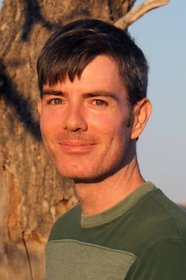
Christopher Phelps lives in Santa Fe, New Mexico, where he teaches math and related mysteries. Queer and neurodivergent, a twainbow underwrites his creative steadfascination. The author of the poetry chapbook Tremblem, as well as the full-length collections Cosmosis and Word Problems, his poems have been published in journals including Beloit Poetry Journal, Boston Review, The Kenyon Review, The Nation, and Poetry. Find more at christopher-phelps.com.