

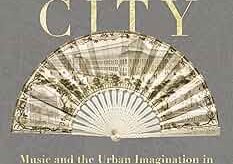
Fanfare for a City: Music and the Urban Imagination in Haussmann’s Paris
Jacek Blaszkiewicz
University of California Press, Jan 2023
A street cry, transcribed, is no longer a street cry. It is a notation, a file, a thing the prefecture can produce on request. Jacek Blaszkiewicz's Fanfare for a City is in one sense a book about the transcription—about what Second Empire Paris did to its own sounds when it began, with administrative thoroughness, to write them down.
Haussmann appears here less as a figure than as a barometric reading. The boulevards are cut; the markets are rebuilt; the cafés-concerts proliferate under license; and somewhere underneath all of it the voice of the marchande des quatre-saisons becomes a thing the city can permit, restrict, transcribe, or refuse to renew. Blaszkiewicz reads this as urbanism producing music, not the other way around—music as the residue, the witness, the policed thing.
The book moves through five sites: Haussmann's own musical imagination, the Expositions universelles, the café-concert, street music as regulatory object, and the street cry. The chapters are organized like a piece of music—variation and contrast—and the structure does what musicologists rarely permit themselves: it accepts that the city is composed, not merely scored. Chapter 4, on the licensing of street music, is the legal chapter. Chapter 5, on the cries, is the elegy.
The cries were old. They had been transcribed before, by Charpentier in the seventeenth century, by Janequin further back. What changed under the Second Empire was the apparatus around the transcription—the police ordinance, the noise complaint, the permit fee, the brigade of agents. The cries did not survive as cries. They survived as files. The compositional record we now possess is, in this sense, what remains after enforcement has done its work.
Blaszkiewicz is good on this. He is best when he lets the regulatory record speak for itself—the ordinance, the protest, the dossier on a particular vendor—and less compelling when the book pauses to perform the methodological gestures sound studies expects of it. The framework occasionally muffles what the archive is already saying clearly. The voice of the marchande was being collected for the same reason the boulevards were being widened: to make the city legible to itself, and to make the illegible parts removable.
There is a seam, and the book half-names it. Blaszkiewicz parts company with Esther da Costa Meyer's Dividing Paris on whether Second Empire spectacle recalls the ancien régime. He thinks it does not; he thinks the Expositions universelles are the prototype of something new. He may be right. But the regulatory machinery he describes—the permit, the file, the cry rendered as carbon—is not new at all. It is the same machinery that licensed corporations and confraternities under the old regime, refitted for steam. The reader is left wondering whether the rupture Blaszkiewicz wants to draw between the old city and the new is, in the end, an administrative continuity wearing a fresh uniform.
This is the book's real force: it shows how culture survives not outside administration, but through the very documents that helped diminish it.
The book holds because it has been listened to as well as read. The Second Empire's sound is, on Blaszkiewicz's account, the sound of a city tuning itself—not always melodiously, not always with consent, sometimes with the brass of a fanfare and sometimes with the silence that follows a confiscated barrel organ. What he restores is the relation between the two. The fanfare and the silence are produced by the same hand.
The cry was vanishing. The prefecture wrote it down. The notation survives in a book published by the University of California Press, where a reader in another century may now consult it, and may even, if they listen carefully, hear what the file was built to replace.
J.M.C. Kane is the author of the non-fiction book Quiet Brilliance: What Employers Miss About Neurodivergent Talent and How to See It (CollectiveInk UK). He is an ASD-1 and writes from this learned experience. His prose work has been published in more than three dozen literary journals & magazines, including Plough, Camas, AMERICA Magazine, Commonweal, Smokelong Quarterly, and The New Ohio Review, where he won the 2025 Ellis Prize for Non-Fiction. He lives in New Orleans with his family where he works as an environmental attorney.