IN MEMORY OF MOTORCYCLE RACER
VASILY KOLISNICHENKO
Sometimes, it happens that something incredible, or simply seemingly incredible due to the stereotypes of our thinking that have developed over the years, unexpectedly intertwines with the familiar web of predictable events. It is at such moments that it is perhaps worth reflecting on the well-known saying: “God works in mysterious ways.”
One way or another, but, when, on a hot July day the director of the children’s seaside health resort where I worked as a teacher asked me to meet at the central gate and accept in my group of a child whose mother had brought him on vacation, I, leisurely walking along the pink gravel path, did not imagine, of course, that the seemingly routine meeting of a new little person would later result in the acquisition of new friends, real friends, one of whom would soon be gone.
The little person turned out to be a short, fair-haired nine-year-old girl with a short bob, wearing colorful shorts and a bright green T-shirt. She was standing near the open rear door of a car. Behind her, on the seat, my eye caught an unnaturally large bag, clearly prepared by her mother for a child.
“Hello,” I immediately addressed the girl, who looked at me with an intense, attentive gaze.
“Hello,” she answered hesitantly, glancing first, for some reason, at her mother and then back at me.
I asked:
“What’s your name?”
“My name’s Dana, well, I mean Bogdana if you’re going by the full name,” the girl replied, just like in class.
“Good afternoon, my name is Tatyana,” the girl’s mother immediately introduced herself, “and are you our teacher?”
“Two minutes ago, I was told that yes, Tatyana, I will be your child’s teacher, and my name is Yurii,” I answered briefly.
Usually, in situations like these, I don’t waste time on long conversations with the parents of the children I am about to work with; instead, I immediately begin getting to know my new pupils. After all, it’s important to build good relationships with them from the very first minutes, or even seconds.
“What city are you from?” I asked.
“I’m from Dnipropetrovsk!”
“Wow! So we’re fellow countrymen? I was born in this city, although I haven’t lived there for a long time. And what school do you go to?”
After Dana gave me the school number, it turned out I knew her teacher well, having worked with her at a summer camp for children back in the day. Then Tatyana decided to tell me she’d also attended a different school, and it turned out she’d attended the very same school my father had headed many years earlier. Later, my older sister on my father’s side had headed that same school at the very time Dana’s mother was a student. It’s not for nothing that they say, “The world is closely.”
Dana quickly made friends with both her peers and me. I couldn’t help but remember a unique incident that happened to her at the beach on the day of her arrival. After nap time and the afternoon snack, the children and I headed to the sea. However, all of them, except Dana, knew the simple rule: namely, to line up in a single file after leaving the water and count each other out loud. This tradition is decades old; I remember it from my childhood, but the new girl in our group had never experienced it before. The sea was a bit rough that day. However, the children and I had swum in stronger waves before, so we went into the water. The overcast but not rainy weather allowed us to do so.
We swam for ten minutes. I timed it with my waterproof watch, and when the kids emerged from the water onto the shore, there was one less person standing in line than had entered the water. Dana wasn’t in line. As soon as I realized this, I quickly turned around and glanced at the place where we’d left our things, under an awning that provided shade from the sun and was located twenty meters from the water. Our beach bags, towels, and blankets were still there, but the girls weren’t under the awning. All the kids looked at me with fear, and I quickly crossed myself and jumped into the storm-clouded water and began, diving, surfacing, and diving again, slowly moving along an imaginary line parallel to the shore.
Suddenly, surfacing once again, I heard the loud screams of my charges on the shore and, out of the corner of my eye, noticed the children jumping on the sand and waving their arms, trying to get my attention. Then I caught sight of little, frightened Dana, wrapped in a huge towel. It turned out that when I was looking under the awning, I hadn’t noticed her, wrapped in a towel and squatting behind a pole. The children were shouting at her and excitedly explaining something, gesturing expressively. When I ran out of the water, the first thing I did, after assessing the situation, was say: “Don’t yell at her. Dana isn’t to blame for anything. She didn’t know that you can’t run to the awning after leaving the sea until everyone has counted. It’s my fault. I didn’t properly explain the swimming rules to her.”
Fragile Dana, still shivering from the cold, looked at me in confusion, beginning to understand how scared everyone was for her. However, the children in our group were generally kind, and after my words, they began to reassure her and explain in detail how we bathe.
Thus, the seaside summer days dragged on, or rather, flew by, filled with games, competitions, children’s secrets and discoveries, arguments, reconciliations, naive tears, and laughter—in short, childhood. The weeks flew by, and on the last day of the children’s vacation, parents arrived from morning until evening to take their rested children home.
Dana’s mother was planning to pick her up the next morning; at least, she had told me so by phone. Two other girls, Anya and Yana, who were Dana’s age and friends, were also supposed to be picked up the following morning. Only after that was I supposed to leave the resort. However, Dana’s mother, Tatyana, a very extravagant woman, as I later realized, arrived on the official departure day, not the next morning. She arrived right after dinner. Her Subaru was towing a trailer with a sports motorcycle.
“I took this to practice,” she commented on the surprised look I cast at the trailer as I brought Dana to the gates of the children’s resort to meet her mother.
When Tatyana learned how many children hadn’t yet been picked up by their parents, she simply asked, “Do you drive?”
“Well, yes,” I replied, somewhat surprised.
“I have an idea. Call the girls. We’ll take them to the hot spring. They’ll love it. It’s about seven kilometers from here. You drive the car, and I’ll ride the motorcycle, so I can practice at the same time.”
Even though I’d only driven manual cars up until that point and had only a theoretical understanding of driving automatics, our trip to the hot springs was a success. However, when I got behind the wheel and settled the children in, my hand automatically reached for the key to turn on the ignition, but to my surprise, it wouldn’t turn on.
Then I heard Dana’s soft, delicate whisper in my ear:
“Press the brakes!”
I laughed heartily, remembering that automatic cars only start when you floor the brake pedal.
After working at the seaside resort, I had actually planned to take the train to Dnipropetrovsk to visit friends and then head home. However, the train journey was unnecessary, as Tatyana offered to take me with her and Dana in her car to my hometown.
Then autumn began a chain of events that unfolded much faster than summer. School started, math lessons began, and there were extra classes for homeschoolers—in short, it was an incredibly intense pace. But during the November holidays, fate again brought me to Dnipropetrovsk, and I accepted Tatyana and Dana’s invitation. They asked me to definitely stop by for a visit when I was in the Dnipropetrovsk region. I treated Dana to sweets, and they treated me to a sumptuous dinner. That’s when I met Vasya, the name of Tatyana’s husband, a man of about fifty. He introduced himself very simply. The man extended his hand across the table: “I’m Vasya, and Tanya is my wife, and Dana is my daughter. I already know you from Dana’s stories. But we’re probably the same age, so let’s call each other by our first names, without patronymics.”
Without hesitation, I immediately agreed, meeting the surprisingly open yet profound gaze—seemingly penetrating some hidden part of me—of the thin, dark-haired man I’d recently met, who would later become my friend. His handshake was firm. But what kind of handshake could a man who earned his living with calloused, work-worn hands offer? Vasya was a long-haul truck driver, and forty-year-old Tatyana had done everything. She’d tried to open a beauty salon, set up various retail outlets, and secure city hall contracts for small construction projects—in short, she was a businesswoman.
There are people who radiate, in an invisibly inviting way, not exactly kindness or friendliness; no, perhaps it would be more accurate to say they radiate humanity. Have you met many such people in your life? No? I haven’t met many either, but Vasya was exactly like that. I couldn’t bring myself to call him Vasily, just Vasya. Why? Probably because four years before the summer that brought me together with Tatyana, Dana, and her dad, my best friend, with whom I went to school and then to university, passed away. His name was also Vasya. He, too, radiated humanity.
After lunch, Dana’s parents didn’t let me go but persuaded me to stay at their country house for a few days. There followed fishing, barbecues, and heartfelt conversations with Vasya, sometimes until the early hours, and, of course, motorcycle riding, which turned out to be a passion not only for Tatyana but also for her husband. In other words, it was Vasya who first taught Tatyana to ride a motorcycle and then dragged her along to competitions. After a while, she started competing in motocross herself.
One evening, I was picking nuts in the yard when Vasya, returning from training, barely opened the gate, glanced at me, handed me his helmet, and said, “Come with me to the center of the village. We need to buy some bread.”
I eyed the brightly decorated motorcycle warily, with the number “31” on the round white shield instead of a headlight and the rear fender raised high. However, out of curiosity, I agreed and, as confidently as it seemed to me, climbed onto the seat behind Vasya. To say I later deeply regretted it would be an understatement. It wasn’t a ride, but a flight, or rather a series of jumps from pothole to pothole along a rutted village road yearning for asphalt, on a wildly roaring machine called a sportbike.
When we reached the store and bought some bread, I firmly decided to carry it home on foot. But things turned out differently. Vasya, laughing good-naturedly, insisted that we ride back together. So, as I stood up in the courtyard, my legs wobbly and not quite believing this unexpected journey was over, it occurred to me that I had experienced similar sensations back in my student years. Back then, I was flying (airfare in the Soviet Union wasn’t much more expensive than train tickets) from Dnipropetrovsk to Kyiv, and just as we were approaching the airfield, for some reason, the landing gear wouldn’t release. The winged machine made several passes, many passengers began crossing themselves, and finally, we managed to land. Back then, my legs were just as wobbly, and I couldn’t believe I had managed to stand on them on the ground.
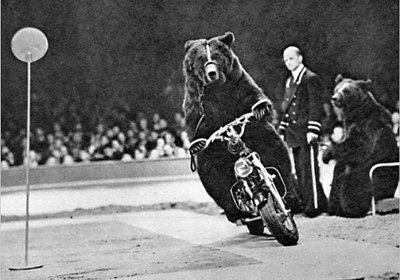
Although Vasya later, in our long kitchen conversations over cups of tea, threatened to teach me how to ride a motorcycle—claiming that even bears in the circus can do it—I didn’t get behind the wheel of a two-wheeled vehicle. Instead, I watched Vasya’s training, not imagining until then that it was possible to fly above the ground at such incredible speed, sometimes soaring several meters and miraculously not falling upon landing, as well as making incredible turns in which the rear wheel skids in front of the front.
The helmet—that’s what I remember most from our perilous journey to the center of the village to buy bread. A helmet that I thought made me look ridiculous, but which, at Vasya’s insistence, I was forced to wear. Later, much later, when I chanced upon one of my former pupils, a professional motorcyclist, and got into a conversation with him, I learned that a helmet for motorcycle racers is, in a sense, an integral part of their being—an indispensable, that is, an absolutely mandatory piece of equipment. Why, then, several months after we first met, on that fateful summer day for him, Vasya was riding his motorcycle through the center of the village without a helmet, I don’t know.
People later said all sorts of things . . . Why did he make sharp turns along the road, like in training? Why did he accelerate and brake abruptly several times, leaving black streaks of rubber on the asphalt? What thought suddenly struck him, compelling him to race on his two-wheeled vehicle, which had become almost his relative—not even a motorcycle, but a mechanical creature? What compelled him to express himself not on a racetrack, but in the village, in that last race Vasya had ever had on Earth, with the piercing roar of the engine and a speed that was only manageable up to a certain point?
A rock, then a rock, hit by a wheel, a fall. Ambulance, intensive care. Two weeks in a hospital bed, unconscious.
I was far away at the time, in another city, and when I learned what had happened, I came straight away. The door to Vasya’s house, as usual, was open. When I entered, Tatyana was just running out into the street. She was always a woman of few words, and so, after greeting me once, she said curtly:
“I’m going to the city, to the hospital. He’s on an IV. He needs some meds. Dana’s sleeping. Keep an eye on her for now. Warm up her breakfast later. It’s on the stove. And yours too. You just got off the train. That’s all. I’m running.”
After seeing Tatyana to the gate and waiting for her Subaru to disappear around the corner down the dusty village road, I returned to the house and, taking a packet of ground Arabica coffee from my bag, brewed myself some bitter coffee. Then I sat at the table for a long time, my head in my hands. One question hung in the air during those moments: “Will Vasya be able to pull through?”
I didn’t wake Dana; she woke up on her own and quietly entered the kitchen in her pajamas, unsurprised by my presence.
“Hello. Where’s Mom?”
“She went to the hospital to see Dad.”
“Oh, right, she said she needed to drop off some medicine in the morning.”
“We’ll have breakfast now, Danochka!”
“No. I don’t want to eat,” she said, sounding a bit mature, and I didn’t insist, as the girl sat down at the glass table that Vasya had made with his own hands at Tatyana’s request.
Dana sat down across from me and looked out the window. The house stood on a hill, overlooking a ravine covered in dense vegetation. Far in the distance, almost on the horizon, an express train sped by. A candle sat in a cup of sand on the windowsill. For some reason, Dana carefully moved the cup onto the table with both hands, then picked up the lighter lying on the windowsill and lit the candle. We were silent for a few minutes, peering intently into the timid flame. Suddenly, Dana looked me in the eye and asked:
“Tell me, do I look like my dad?”
“Of course, Dana, you’re kind, just like him,” I answered immediately.
Then we gazed thoughtfully at the flickering flame again. This went on for about two minutes, and then Dana, unexpectedly and abruptly, with two fingers of her small hand, without fear of getting burned, snuffed out the candle. I, for some reason, automatically glanced at my wristwatch. It showed 8:45.
Tatyana returned half an hour later.
“It’s impossible to go to the city and come back so quickly,” flashed through my mind.
Dana’s mother, pale-faced and slowly walking to her room, said absently, “While I was in the car, Vasya’s sister, who was sitting by his bed, called me and said he died at 8:45. He doesn’t need any more medication.”
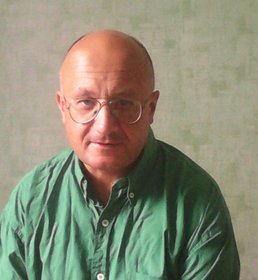
Yurii Tokar was born in 1967 in the USSR. In 1988, he began teaching mathematics in the region affected by the Chernobyl disaster. His stories, essays, and poems have been published in Ukraine, Germany, the USA, and elsewhere. For example, his work has appeared in the Russian-language magazine Чайка (Washington), Litbreak magazine (USA), and StylusLit journal (Australia).