

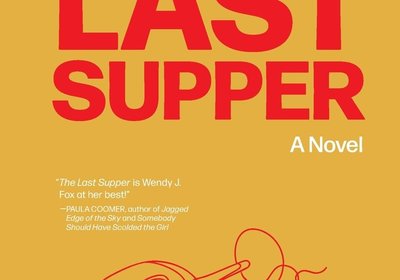
The Last Supper
Wendy J. Fox
Sante Fe Writers' Project, Apr 2026
I first realized I was old a few years ago. I was collaborating on a play with a young, talented director and they asked me what Brooklyn was like for artists of my generation. My generation? Good lord. It took me a few moments to understand what she said. I had spent so much of my life being the youngest person in the room that I didn’t recognize that this person was fifteen years younger than me, in elementary school when I moved to Brooklyn. Reading The Last Supper reminded me of this encounter, that feeling of realizing your youth is gone and the desperate scramble to find something of value in the life you made so far.
Wendy J. Fox’s latest novel takes place across a month, from May to June, opening on the protagonist Amanda’s 40th birthday party. It’s a party she’s thrown herself, attended by her phlegmatic husband, two young sons, and handful of girlfriends and their forgettable husbands. She’s obsessed with details like the gluten-free cake (“[g]luten-free was just for the hashtags”) but, juggling responsibilities, she executes them poorly. Smudged with icing in an ill-fitting dress, she announces to her friends that she’s launching a lifestyle brand, AMANDAtory. She wants to be an entrepreneur like Martha Stewart but the modern stay-at-home mom version.
As an aspiring momfluencer, Amanda is more relatable than aspirational. She struggles with her weight, she doesn’t shower as often as she’d like. The book mirrors the banality of a mom’s everyday life with many pages about what to make for dinner, the need to bathe her children. How often the day ‘cre[eps] away from her again”.
The lifestyle brand seems to be an escape from this reality at first. Her expectations for her account to be a popular brand unveil disturbing truths about herself and her friends. She laments about how influencing wasn’t a ‘thing’ when she was getting married and daydreams about using her friend’s upcoming nuptials as a photo-op. Perhaps most telling, in one scene, as she and her photographer friend attempt to make content, she allows her toddler to become cold and upset in order to ‘get the photo’.
”Is it okay if he starts crying again? Because I’d really like to get a shot of him crying.”
“That’s fine,” Amanda said. She bit into her sandwich.
As much as Amanda wants her life to become a viral performance, no one is watching. Her few followers are mainly bots, her husband is distant. She has an audience of no one. When her absentee husband commits a major betrayal, her mother encourages her to share, telling her “[y]ou haven’t said anything about this personal crisis on your platform.” Now that she has something to actually post, though, Amanda is unsure about the exposure.
Ultimately, the social media account is less about Amanda’s vanity and more about creating a space where “people would listen to her”. Despite how much importance Amanda puts on appearance, Fox shows us that everyone’s life is a mess. All of Amanda’s friends are engaged in horrible relationships to one degree or another. Her perfect mother seems to be constantly drinking. In attempting to commodify her imperfect life, Amanda realizes that #reallife is depressing. Her attempts at performance make her more lonely as she is living for her phone and its timer for the next chore.
At the end, she goes for a walk around her suburb to nowhere in particular but she is without her phone. She notices flowers, trees, animals, all of the things she’s surrounded by but doesn’t know. In that moment, “[s]he remembered what it was like to give a shit about something that was not just her own, immediate material concerns.” While Fox offers us no definitive answers, readers are left knowing that Amanda is starting to see the world around her and that is hopeful. Fox’s The Last Supper is an astute exploration of what it means to be a woman in a patriarchy, where we are forced to curate our lives for public approval, where our only opportunity for expression is the echo-chamber of a phone’s screen.

Jesi Bender is an artist from Upstate New York. She is the author of the novels Rhododendron (forthcoming 2027), Child of Light, and The Book of the Last Word; the plays Crux and Kinderkrankenhaus; and the poetry collection Dangerous Women. Her shorter writing has appeared in FENCE, Denver Quarterly, Sleepingfish, and others. www.jesibender.com