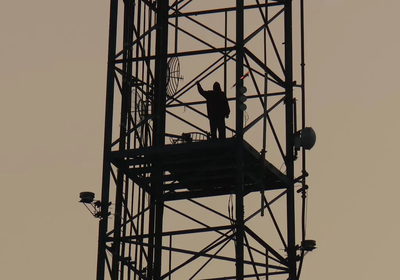
He had been driving by the new guyed broadcasting tower in Wilma, just on the outskirts of town, when he noticed the outline of a man perched at the top. He pulled over and shouted if he were okay. No one answered. So he took off his coat and rolled up his sleeves and began to ascend the ladder—after all, he had been at the paper for over a year and not yet himself the subject of an article—but not until he was nearly to the top did he hear a voice cry out above him: “Don’t you come any closer! I’ll jump if you so much touch me!” It was Abe DeBosier, local drunk and part-time plumber. Abe explained how he was sure his wife was cheating on him. He had walked in early this morning from another bender, and there on the dresser was the watch of another man. He did not know to whom it belonged, but the breed of the watch was fancy.
“It’s all right there in the note. I told her what I’m set on. I says, ‘You turn on the five o’clock news, you gonna see the pain you done me.’”
It was ten-thirty. He had been hoping to have the office opened a half hour ago, but he could not resist stopping in at his favorite pie place, and now there were two lemon meringues deliquescing on the back seat. Such was his kind of luck these days.
“Come on, Abe. I’m sure this can be sorted out with reason. You don’t want to kill yourself.”
“We been married eighteen years, me and Donette. The two of us was high school sweethearts. She bore me three children. It don’t matter that two of them turned out no good. I give her the best years of my life. And now for her to go running round . . . for her to go doing this to me . . . It ain’t right, Kendal. She gotta pay the piper for what she done. And see that she broke my poor, poor heart.”
Then exactly what he did not want to happen happened. Someone must have alerted the channel news, for within ten minutes of his being up there a crew had set up beneath the tower—he could see the camera on the tripod aimed at them with the intent of catching those morbid last seconds when Abe would meet eternity—and they must have alerted the sheriff because soon a cruiser was tooling around the base before cutting the engine.
“I think he should see this as an opportunity to move on,” said Sheriff Guidry. “Donette’s been holding him back for years. I just always assumed he knew what was going on, was okay with her running round with half the town. It might be one of them . . . what do you call them?”
“Blessings in disguises.”
“Maybe,” said Sheriff Guidry. He was chewing his tongue in preparation for eating the doughnut that he held, the doughnut of course having been given to him by the news crew with whom he had been spiritedly conversing.
“I reasoned him all I could,” said Kendal, “but he’s set on her seeing him kill himself.”
“Well, you’d think he’d have a little consideration for his viewers. I gotta drop me off the cruiser at Willert’s today before lunch if I want them motor mounts fixed by this evening. It sure makes patrolling sound like some jackass is coming round the corner.”
So Kendal climbed back up and tried to reason with Abe once again.
“You know the five o’clock news doesn’t necessarily air things that are live. Often they’ve been recorded and edited during the day. Why don’t you come on down and quit this foolishness now.”
“Oh no,” said Abe. “I do that, they fixing to get me on disturbing the peace. I’m fully committed. Just like Donette was supposed to be. Only way they gonna get me to come down is at the behest of gravity. I want her to see what she done to me, Kendal. What she drove me to. I want her . . . to see how she broke my poor, poor heart.”
There was really no getting through to him.
He stood there over the prairie, watching a flock of crows playing around a tree. The morning fog that had been hanging over the river and the basin was scarcely present in the east. Some years ago, when he was an intern, he had written a story about the crows in St. Joseph Parish, which had been causing the cattle farmers problems. They would swoop down on newborn calves and peck out their eyes, not to eat them, the eyes, but as a kind of game, and their running the article had led to the unofficial open season on crows, vultures, grackles, blackbirds, kites, and hawks. Even starlings. People did not want to take any chances. Kendal’s article had been so effective that within two months the species had been all but wiped out from the parish. Now, watching them dive down and tumble about the grass, he was glad to see them returning—if not that it was a judgment that his article had ultimately lacked staying power.
Perhaps a quarter mile beyond the tree and the birds was Bayou Pompon and a skiff anchored between the banks. He clung there to the tower for so long, working on old Abe, that he saw the man in the boat reel in what looked like a sizeable carp, then another, and then the boat moved on, and he could feel himself becoming sunburnt around the neck and ears, and he cursed Abe’s wife for not being more considerate in her philanderings. Tomorrow’s Examiner would be thin, and not only would the parish have already heard about Abe’s death from the TV news, but they would be confirmed in their thinking he was an idler.
Two more patrol cars drove up. They had the lights off, but after they had parked and stepped out and conversed with the sheriff, they went back and let the lights and sirens run for a spell. Kendal took this as a summons for him to come down. His arms, knees, and neck were sore, had the feeling of having been caned.
“She’s dead,” said Sheriff Guidry, “Donette is. Look, we got to break it to him, and the way I see it, the sooner we do, the better. When he asks after her, here’s what you gonna tell him: She and that fella had their bags packed and were planning on skedaddling. Only they didn’t make it too far. I suppose in all their smooching the two of them were paying not too pretty good attention, and an eighteen-wheeler making a chicken delivery ran them over as they were coming out onto the highway. Wreckage and feathers everywhere.”
“Jesus,” said Kendal. “What a world.”
The news crew was resting in the shade of an old pecan tree, two of them waiting for Sheriff Guidry to return to playing cards as another one slept.
“Yeah, talk about your misbegotten love nest. Now go on up there and tell it to old Abe.”
So for the third time he was up at the top of the tower, what must have been going on two thousand feet. The height itself did not bother him. It was the stubbornness of both parties, man and wife, to maintain their courses of action with blanket disregard for any business but their own. It was then that he vowed never again to stop if he spotted another suicide-to-be. There should be some sort of law outlawing the good Samaritan—not too tepid a topic for an editorial if written with proper eloquence and tact.
“She’s dead,” said Kendal, “Donette is. Yeah, I can’t believe it either.”
“Why?” Abe was staring at the ground, at the irregular quilt of roads, woods, bayou, and pastures, as though it had all somehow conspired to betray him.
“I guess it was her time.”
“No. I says, ‘Why?’”
“They were in his Pinto, turning onto the highway, and apparently he didn’t look. Sheriff Guidry says they died right there on the spot. Sorry, Abe. It’s a hell of a way to go.”
He was going for brevity now, succinctness, over consideration for the audience.
“So she ain’t gonna watch no five o’clock news?” He reminded him of a child who is convinced by the reality of his desires.
“Afraid not.”
During the quiet of their thoughts a pungent breeze reached them from off the bayou. It was a breeze of life and decay, and he could feel the tower gently sway within its current. The chatter of the officers came up mumbled and indivisible, and the early evening light was making the area around the bayou look golden, as though fashioned of an element in varying grades of purity, and the journey down seemed a descent to such a land of beautiful defeat.
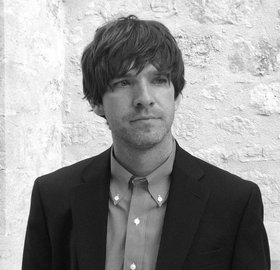
Devin Jacobsen is the author of the novel Breath Like Wind at the Dawn and the story collection The Summer We Ate Off the China. He lives in Paris.