Goethe's Oak
John T. Price
Ice Cube Press, Sep 2025
Has anthropomorphism been rehabilitated? Not so long ago it was derided by certain high-minded readers as sentimental, the stuff of children’s literature. (A dubious argument, because what’s “wrong” with children’s literature?) Lately, though, it feels as if the tables have been turned. Now it’s the human-centric narrative that is open to criticism of being blinkered and parochial. There’s a new interest not only in other species, but in the plant world, too.
John Price’s genre-bending Goethe’s Oak is written from the perspective of a tree. Hybrid texts—somewhere between poetry and essayistic musings—allow the author to experiment with a curious sort of speculative translation, of a tree “talking.”
And not just any tree. Subtitled “A Holocaust Story,” it refers to “Goethe’s Oak,” an ancient tree and landmark by a trail near Weimar where, according to tradition, Goethe would meet his beloved Charlotte Von Stein and where, in 1776, he composed his poem “Wanderer’s Nightsong.” Later, when the Nazis cut down the surrounding forest to build Buchenwald, they spared the tree because of its venerable reputation and treated it as a symbol of German superiority. (The image of the oak leaf figured on their highest military honor, The Iron Cross.) In a fascinating introduction, Price relates how accounts from camp survivors variously described the lone standing tree as a cherished reminder of life outside the camp, or as a site of torture, to which prisoners were sometimes tied.
It appears that within a few years, due to the altered ecosystem of the tree’s surroundings at Buchenwald, the tree began to die, and it was seriously damaged in 1944 by Allied bombing of a nearby munitions factory. What remained of the tree was felled in Spring 1945, and since then, the large stump has become a site of remembrance, on which visitors place small stones, in accordance with Jewish tradition, to honor the dead.
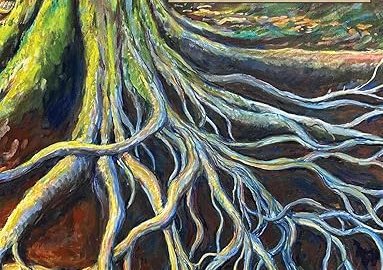
Recently, Price explains, humans have begun to better understand the connections between trees, how they depend on “vast underground networks of the symbiotic fungi known as mycorrhizae,” which are “intertwining fungal rivers” that “supply nutrients and water between trees but also communicate warnings that trigger innate biological defenses.”
From which, the author makes the imaginative leap of seeing the “fungal rivers” as “living words.” Or, as he puts it in the perspective of the tree: “From where it flowed I did not know. Only that it was there and it was good and it was not me.” Or, elsewhere:
We are not the words others use to name us. We are ourselves, never fully known, even to us—like the sky above, the depths below. There is always more. More to become. We may think we know what we were before, in the beginning, but can we really know? When did this being-ness begin?
This struggle with words, with naming, whether alluding to Goethe’s unrequited love or to the holocaust, or to processes specific to the tree community, is central to Goethe’s Oak. Also, since the voice here spans centuries, its witness is informed by a scale of time that is different from human habits of thought. Even after the oak has been cut down, the voice persists, like a chthonic Whitman, via the fungal rivers underground:
Spring arrived, but not for me. No flowers, no leaves. No sky. I was far below the surface when I awakened in the dark, the cold. Alone. Afraid. Then, from the depths, like a hidden wellspring, came a murmur, very faint. As when life first stirred within me. Could it be? It was only a trickle of her living words, but it was enough for me to know. The One. [. . .] Now, at last, I had returned to where she and the others had always been, even in sleep. The forest. Home.
This is a strange book, but agreeably so. It is not exploitive or sensational, despite its difficult subjects. Its allusions to One-ness and inter-species empathy involve a metaphysical element about which I’m personally uncertain, but throughout these pages there is a sober and thoughtful engagement with life on multiple levels, both above and below ground.

Charles Holdefer’s new novel, Move the Mountain, will be published in 2027.