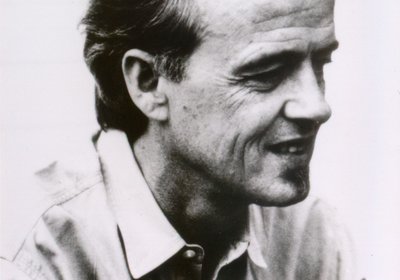
James Tate died in 2015 at the age of seventy-one, after a lifetime devoted to poetry and having won just about every major award, starting with the Yale Younger Series of Poets Award in 1967 when he was only 23, and including a Pulitzer Prize and a National Book Award, among many others. By any measure his career was a huge success, not least in his influence on succeeding generations of poets.
Certainly he has been a key figure in my life as a writer. Few poets have challenged my fundamental notions of what poetry is or can be more than Tate. I have had countless one-sided arguments with him because, it must be said, he infuriates as often as he delights. Since his death I have increasingly found myself reflecting on his example, and when stuck in a poetic corner I sometimes ask myself, “What would Tate do?” knowing that, as like as not, it would be something that would perplex or annoy me. Whole books have been and will be written about him, I’m sure. My purpose here is to look at a few key aspects of his work, and the light they may shed for the rest of us on the process and goals of writing poetry. In particular I want to examine his lifelong urge toward the outer edges of surrealism and dream logic, and how in the end he found a way to tether that urge with his discovery of the power of narrative, and in the twilight of his career produced what I believe is some of his very best work in the form of transcendental prose poems. Once he started writing them, he never looked back, never returned to his previous free verse, although there remains a good deal of overlap between the two.
According to my thoroughly subjective and personal evaluation, Tate’s work can be divided roughly into thirds. One-third of his poems are nonsensical tripe, little more than random gibberish, a lot like early- to middle-period John Ashbery in such poems as, say, “Leaving the Atocha Station” (feel free to kick me in the head if that is one of your favorites by Ashbery). Another third of Tate’s poems are failures of one kind or another, but interesting failures with bits of brilliance embedded in them. The remaining third are among the finest poems of our time. What’s more, they are fine in ways that are nearly unique to Tate. No one else could have written them. No one else could have shown us this hallucinatory yet recognizable take on the world.
Did he know which of his poems worked and which didn’t? Apparently not, because he published all of them. Perhaps a more interesting question is, did he have to write all of the senseless and failed poems in order to write the really good ones, which are not all that different in approach, only in effect?
An example of the first kind of Tate poem, the meaningless kind, is the final poem from a numbered cycle of twenty with the overall title of “Absences,” which is also the title of his third full-length collection from 1972. It begins:
Toto, I don’t think we’re in Kansas.
The orange glow of an erased creature
murdered in comfort by mama’s ax
flies into the organ.
Somewhere around the middle of the poem there is this:
And eleven elves drop dead
in the basin of gold trousers.
And it ends like this:
Nearing an island,
I forget to wave. It is too beautiful
to excite me with the idea
of accessibility.
I won’t try your patience any further by pretending to analyze this one. Obviously it defies analysis. The opening could be seen as an oblique warning that we’re about to enter uncharted waters, and the ending sort of ties up that idea. But nothing in between makes any kind of sense whatsoever. There is simply the empty feeling of arbitrary words and images rubbing up against each other without adding up to anything. With the exception of the final two sentences, you could rearrange the lines in this poem in any order and it would have the same impact, or lack of impact. That is never a good sign.
Tate wrote many poems like this, around the same time as Bill Knott was also experimenting with extreme surrealism (or aurealism as he quirk-ily called it), and the same time as Thomas Lux was deciding that, for him anyway, surrealism was a dead end. Knott and Lux found their own ways forward out of the surrealistic swamp. For Knott, it was an intensely idiosyncratic formalism overlaid with wit and savage satire. For Lux, it was a realism rooted in a very generous and nuanced sense of reality, almost Shakespearean in scope. For Tate, as we shall see, it was learning how to use narrative. It’s worth noting that the three poets were mutual friends and occasional collaborators. Lux edited Knott’s posthumous volume, I Am Flying into Myself: Selected Poems, 1960–2014, and Tate and Knott co-wrote a little-known verse collection called Are You Ready Mary Baker Eddy??? as well as the experimental novel Lucky Darryl (good luck finding either of those!).
I should pause here to note that I am not denying the legitimacy of surrealism as a literary technique. I admire its expert use by others and often use it myself, and have even had a chapbook published by SurVision Books, a surrealist house in Dublin, Ireland. What I’m saying is that surrealism by itself did not prove to be a sustainable technique for three of the best American poets born in the forties. I also find it interesting that John Ashbery, a poet-mentor admired by all three of them, also ended up adopting a much more direct and clear style in his later work. Go figure.
I don’t think we have room here to deal with Tate’s interesting failures, and why they’re failed but interesting, so let’s skip straight ahead to the best stuff. In his last book before he switched to writing prose poems exclusively, 1997’s Shroud of the Gnome, he began to introduce more sustained, coherent narrative into his work. We are storytelling creatures after all. It’s in our DNA. As a result almost any statement, no matter how bizarre, can take on an air of normalcy and plausibility when told as a story. It’s a clever way for a poet to smuggle in odd, dreamlike elements and incorporate them into a meaningful whole. The title poem is an excellent example. It opens in mid-scene like this:
And what amazes me is that none of our modern inventions
surprise or interest him, even a little. I tell him
it is time he got his booster shots, but then
I realize I have no power over him whatsoever.
There follows a funny and seemingly unrelated vignette about the narrator trying to pick up a registered nurse at a lunch counter. Then suddenly he is in an alley, surrounded by “piles of outcast citizenry and burning barrels / of waste and rot, the plump rats darting freely.” And at the conclusion (spoiler alert!) he does find the shroud of the gnome:
And now, rejuvenated by the wind, the shroud moves forward,
hesitates, dances sideways, brushes my foot as if for a kiss,
and flies upward, whistling a little-known ballad
about the pitiful, raw etiquette of the underworld.
The poem moves nimbly from humor to a dreamy strangeness (though not quite surrealism), from the mundane to the profound, and in the end is rather heartbreaking. The interlude with the nurse at the lunch counter might seem an irrelevant or distracting bit of comedy at first, but then it segues directly into the “piles of outcast citizenry,” and we realize that the narrator, as well as his “lost friend” the gnome, is equally unable to connect with someone outside of his immediate circle and experience, locked into a loneliness as ancient as humanity and as modern as any industrialized city.
We could get into a technical discussion about why I describe this as a prose poem, even though it is not broken into paragraphs and the text doesn’t wrap arbitrarily on the right. But I’d rather not. I got into just such a discussion with an editor recently and it didn’t lead anywhere useful. Suffice it to say that the long lines, the lack of any metrical or syllabic pattern to the lines, and the recurrent prose-like enjambment are, for me, signs of a prose poem. In any case, Tate himself describes his later work as prose poetry, and that’s good enough for me. Allowing authors the grace to self-define seems the most fruitful course.
After Shroud of the Gnome, which in retrospect is clearly a transitional book, Tate published five more volumes of verse—Memoir of the Hawk (2002), Return to the City of White Donkeys (2004), The Ghost Soldiers (2008), Dome of the Hidden Pavilion (2015), and posthumously The Government Lake (2019)—each consisting entirely of prose poems written in his now perfected narrative style. The first poem in Memoir of the Hawk, “New Blood,” sets the nonchalant yet unsettling tone as it begins:
A huge lizard was discovered drinking
out of the fountain today. It was not menacing
anyone, it was just very thirsty.
The poem goes on to say that the lizard’s “long forked tongue was like a red / river hypnotizing the people, keeping them in a / trance-like state.” It ends with this somewhat mysterious exchange:
“It’s like a different town,”
one of them whispered. “Change is good,” the
other one whispered back.
Indeed, for Tate the change is good. He ropes in his wilder impulses by incorporating them into mini-stories like this, highly compressed and all the more evocative because of it. Does a poetic narrative of this sort have one sure denotative meaning? No. But it has any number of connotative meanings. For example, it can be taken to say something about how people in crowds, people in the aggregate, spontaneously adopt a group identity and behave in ways that might well embarrass them as individuals if pointed out later. There is something both sinister and amusing about this, a mixed message that Tate captures perfectly with his absurd yet threatening imagery of the giant lizard and its thirsty red tongue.
Of course that is only one reading. Many others are possible, which makes these marvelous late-period prose poems by Tate some of the richest in our literature. What brings them into being is his deft use of narrative to give shape to his widely wandering imagination. I’ll leave you with one more, also from Memoir of the Hawk, called “Negative Employee Situation.” It begins:
The Huntingtons had a live-in maid
by the name of Mary. Mary was very religious
and prayed a good deal of the time.
We learn that “Mary pretty much ceased / working altogether and prayed all of the time.” In fact, the mistress of the house now does all of the cooking and cleaning, but “Mr. / Huntington would never rebuke Mary because / he believed her prayers benefited the whole / household.” Then Mary dies, and the Huntingtons hire another Mary, who unfortunately doesn’t seem to understand her real duties. She cleans instead of praying, with this chilling ending:
The Huntingtons were terrified for their lives
and discussed plans for killing the new Mary.
In keeping with the other installments in this series, I want my tribute poem to be related to a poem that I have discussed in the tribute essay. Normally the poem would be from a book I really admire. In this case, however, the James Tate poem that inspired me is from what I consider to be his period of mostly lesser work, basically his middle period. It is “Poem to Some of My Recent Poems,” from the book Constant Defender (1983). For me, it stands out from many of the other poems in the book because the silly, self-referential conceit allows him to make a number of very witty jokes (mainly self-deprecating) and to one-up his idol Wallace Stevens in the Let’s Write Another Great Poem About Poetry Sweepstakes.
Much of the poem is devoted to the demeaning yet endearing nick-names he has given his poems: “My beloved little billiard balls,” “my polite mongrels,” “edible patriotic plums,” “my little rum runners” (again with the diminutive). He also writes of the mother of his poems (another name for the muse I think), who “had defective / tear ducts and could only weep iced tea.” At one point he gives us what I believe is a tantalizing glimpse into his compositional technique, particularly in regard to endings: “I had to navigate carefully around her brain’s / avalanche lest even a decent finale be forfeited.” The ending, like so many of Tate’s best endings, manages to be ridiculous, moving and profound all at once:
as she was dying, I led each of you to her side,
one by one she scorched you with her radiance.
And she is ever with us in our acetylene leisure.
But you are beautiful, and I, a slave to a heap of cinders.

After years of writing humor for the New Yorker, the Onion and McSweeney’s Internet Tendency, among others, Kurt Luchs returned to his first love, poetry, like a wounded animal crawling into its burrow to die. In 2017 Sagging Meniscus Press published his humor collection, It’s Funny Until Someone Loses an Eye (Then It’s Really Funny), which has since become an international non-bestseller. In 2019 his poetry chapbook One of These Things Is Not Like the Other was published by Finishing Line Press, and he won the Atlanta Review International Poetry Contest, proving that dreams can still come true and clerical errors can still happen. His first full-length poetry collection, Falling in the Direction of Up, is out from Sagging Meniscus as of May 2021.