
Luv Slaps
John Oliver Hodges
Broken Tribe, Oct 2025
“It’s a tricky business canoeing through icebergs,” says the narrator of “These Kids Were the Chosen Ones” in John Oliver Hodges’ Luv Slaps. “Oh, but the beauty we experienced, what a sight!”
If this flash fiction collection has a thesis, perhaps this is it—just replace icebergs with the confounding experience of love. Not all of it is romantic in these thirty-nine stories: One comical and oddly relatable standout, “Alive in the Jungle,” describes a clandestine love affair with (more accurately, one-sided love for) a taxidermied monkey.
But, here, almost all of love’s manifestations, sublime as they may be, are shot through with an undercurrent of danger, of threat. Discomfort smolders at the edges, and sometimes at the foreground, of these tales. Love is like a loose tooth you can’t help running your tongue over, even though you know it’s wiser to stop messing with the damn thing.
One can intuit this duality in the collection’s title itself. “Slaps”—overlooking the Gen Z meaning, to describe something amazing, in favor of the old-fashioned verb or noun—connotes both violence and playfulness (if aggression can ever be construed as playful). Likewise, in these stories, love is portrayed not only in its range of splendor, but in its agony: the obsession and animalistic hunger that gnaws behind new blooms of appreciation, the dull thud of disappointment when reality arrives, and the regret and longing that needle after loss.
Here, love’s glory nestles closely with its flip sides: misunderstanding and miscommunication, rejection, physical pain, and the many other forms of punishment to which humans subject themselves in the name of love.
Its stories filtered through a range of narrators and settings—from Queens to South Korea, Florida swamps to Alaskan wilderness—Luv Slaps suggests that love not only exists in an endless variety of forms, but is something you can’t quite outrun; that its pull transcends place, time and (need one say?) better judgment. Perhaps this collection’s underlying point is that love’s requisite danger, its inevitable heartbreak, is what makes the whole enterprise so tortuously delicious, self-expansive and, ultimately, worth the avalanche of trouble.
In many stories of Luv Slaps, it seems the best one can hope for in love is the unadorned and the blissfully entangled, where instinct meets the divine. Raw meat, armpit licking, crude language, shame, blow-up dolls, adultery, domestic violence and ejaculating into anthills all find their place in Hodges’ world of searching, often humorous characters, many of whose proclivities and inner monologues would be relegated to the underground, the fringes and the unspoken-in-polite-company. But traditional, if fleeting, sweetnesses also appear throughout: “kissing in the scraggly woods alongside the highway,” found ten-dollar bills on Christmas Day, a mother nursing her baby.
How quickly, though, love can vacillate from affection to violence. In “The Viewing,” a monument to 9-11 conveys the dangers and blind spots of patriotic love, mirroring the tension between fondness and aggression in romantic love. The narrator’s companion, Nozomi, “has the loveliest nose. Each time I see it I get this impulse to either bite it right off her face or give it a nice little kiss.” In “2 Slaps,” the narrator recalls, “When the girl I was in love with slapped me, I felt warm and alive, like the greatest thing ever. This may well have been the happiest, most contented, meaningful moment of my life.”
This paradox-ridden human condition, in its absurdity, tenderness, comedy and degeneracy, is echoed in the photos scattered throughout Luv Slaps. Hodges, a photographer as well as a writer, prefaces each story with one of his photographs that hints at—or plainly illustrates, like before “The Girl in the Gutter”—the tale to come.
One story, “Melt,” utilizes photography as a metaphor to fine effect. After the first-person narrator opens with memories of dismembering women, the reader realizes a few paragraphs into the story these are pictures, not the fleshy annihilation undertaken by a serial killer. But through the photos’ pieces, Hodges succinctly tells a story of regret, gratitude, and the desire for and impossibility of repair—the mishmash of shards that comprise a bygone love. After scattering these pieces around Queens, the narrator panics and goes to retrieve them. “These rips I carry home with me,” he says. “I put them on the floor and try re-piecing things. I want to repair what’s been broken but nothing fits. All I have is a monster.”
Other stories similarly utilize the mundane to explore the complex realities of love, including the impossibility of outrunning yourself and the grass-is-always-greener mind-trap. In “Noodles and Socks,” wanting and acquiring each create their own problems, and familiarity breeds contempt—or at least disappointment. The narrator, traveling in South Korea, finds his restaurant meal, advertised as “dumpling soup,” is mostly noodles. He bumbles through connections with strangers, scoops up a ten-pack of socks (“scalloped nicely with ocher and navy blue stripes”) at the market, and ponders his recent breakup while meeting the wistful girlfriend of the man who rents him his room. The girlfriend wishes she were back in New York, the region from which the narrator has traveled all this way to escape. When he tries them on, the socks, of course, do not fit.
It’s not the first time Hodges has explored the slippery, transcendent sludge of love. His first short story collection, The Love Box (winner of the Tartt First Fiction Award in 2012), was described as twenty-two stories that “document the torments of young men and women haunted by unreasonable attachments to other human beings.” Writer Barry Hannah, with whom Hodges studied—both share a talent for colliding the comic and tragic—described Hodges’ fiction as moving “like a river of savage wit and supreme visions.” In Luv Slaps, the same could be said of love itself.
“When I say I’m in love, you best believe I’m in luv, L-U-V”: The defiant, youth-gone-wild opening to the New York Dolls’ “Looking for a Kiss” is, in fact, taken verbatim from the ’60s girl group The Shangri-Las’ song “Give Him a Great Big Kiss.” But in the New York Dolls song, sex, drugs and rock and roll create frustrating catch-22s. With love, as with drugs—“I need a fix and a kiss,” broods singer David Johansen—feeling good is inevitably going to go hand in hand with feeling bad.
Hodges, in his other artistic pursuits, stands in the lineage of the Dolls, progenitors of punk rock—as a teen, he played guitar in the hardcore punk band Hated Youth. Readers can also detect a punk rock aesthetic in Luv Slaps: Polished perfection is abandoned for the sprawling, impassioned, confrontational and visceral. This flash-fiction collection is far more interested in dark-humor gut punches than fanciful intellect or flowery prose.
Stories like “Gary Gets Gary,” the collection’s opener, tingle with the literary inheritance of Raymond Carver and Gordon Lish. Generous dashes of repetition, non sequiturs and an engaging voice lend a lilting rhythm, like in the narrator’s internal monologue after a petty quarrel with his girlfriend: “Had it been up to me, a stranger would have come along and murdered me. The stranger could have blown my brains out, fine by me. The stranger could have strangled me. I was open to being stabbed. She needed cheering up.”
Another story, “Dorm,” foregoes typical sentence structure and grammar altogether to portray an innocent and fading love. Its effect is surprisingly poignant:
“Would drove ten. Thousand. Mile. If to be with her a minute, and.
Ten. Thousand. More Chochi would drive. A billion because. Chochi. Love her. With Chochi love, there are no mile, no light year.”
Meanwhile, at the end of “Push Me Down the Ladder,” words devolve into mad repetition and mere nonsensical gurglings (apropos of love and, in this tale, sex). Still, Hodges’ stories are neither gibberish nor amateurish. These linguistic surprises, used sparingly, never overstay their welcome. More often than not, the narrators (most stories are first-person) feel like eccentric but interesting friends who want to fill you in about their latest (mis)adventures. The result is a collection that never lags—admittedly, an easier task in flash than longer pieces, but dull writing can strike anywhere, and Luv Slaps remains sharp and compelling throughout.
Once in a while, a chummy narrator even addresses the reader directly, and indeed we might observe metafictional touches in several of these stories, such as “Forty,” about a man who photographs himself nude in the woods, paired with a photo of Hodges (who is also pictured on the cover) nude in the woods. Indeed, many of the characters of this collection, in various ways, evoke the bewilderment of being alone and naked, exposed to the elements, but taking the time to provide a snapshot of their experience anyway.
The flash-fiction works that comprise Luv Slaps, individually and collectively, transmit larger stories of love and loss, and how closely death cuddles up to our inferno of aliveness (human, animal and earthen) in all of its messy expressions—and, one could extrapolate, how its tenuousness and ultimate demise are what give love (and life) meaning, a la Donald Barthelme’s “The School.”
In one explicit example, the story “Boulders” recounts how a new high school grad fell to his death climbing a mountain in Alaska—old hat for locals like the narrator, who have seen tourists, “hungry for stuff that is new,” who “think they have arrived in paradise, where they cannot be harmed,” perish to the “menacing beauty” that surrounds them.
Luv Slaps assures us that, whether you find it in a person, a place, an idea, or a taxidermied monkey, that’s simply the chance you take with love, L-U-V.
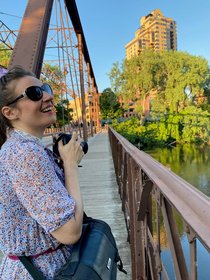
Tracy Morin is a Mississippi-based writer and editor who has been a hand model, rock-and-roll drummer and boxing ringside reporter. Her work has appeared in The Rumpus, Cleaver, Necessary Fiction, Bending Genres and elsewhere. Find her writing and photography at www.tracymorin.com.