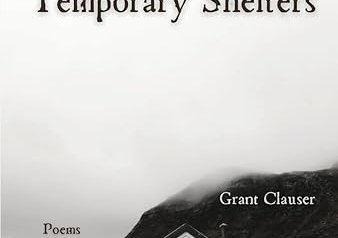
Temporary Shelters
Grant Clauser
Cornerstone Press, Sep 2025
“Nature poetry” is easy to caricature. At one end of the spectrum you find prosaic wonder at clouds, mountains and the dance of bees. The tone is reverent. At the other end of the spectrum, you find green polemic about the depredations of a group of assholes called homo sapiens. The tone is exasperated.
Grant Clauser’s latest collection, Temporary Shelters, could fairly be described as nature poetry, but to its credit, it steers clear of caricature. There are indeed poems about box turtles and the blessings of a dog; he also pulls no punches about the peril to the planet. But the tone here is neither innocent nor angry. It is more subtle and intimate, like eavesdropping on the mind of someone who is very good at paying attention.
This kind of scrupulous attentiveness is an undervalued feature of our so-called “attention economy.” In “Half Crumbled Silo in a Half Fallow Field”, the speaker remarks:
The news today
says kids are breaking. What they know
is the ground is shaking underneath them
and believe that’s all the future holds.
So says the news cycle algorithm, not without reason. But this speaker is at pains to look elsewhere. Standing on the site of an abandoned farm in the descending dusk, listening to the bats, he acknowledges that the world is shrinking but he also discerns ongoing regeneration within the ruin of this “forgotten place.” The place persists, regardless of our forgetting. There is no alternative, no interplanetary Muskian elsewhere. Whether we know it or not, “we can’t move on.” This is not the poetry of moralizing or easy uplift, but of someone who notices that birds and bats have not abandoned their song. Nor, it seems, will he.
Often, the act of noticing involves the perspective gained by stepping back. For instance, here are the closing lines of “What We Make of the Mountain”:
When the casino broke
turf for irrigation, they found
mastodons, tigers, bones
that make the coelacanth
look young, and yes, the sea
once rocked here, and buffalo
nursed their calves, but we’ve
got black mold in the resort’s
new dining room, ragweed
in the AC, customers
demanding attention.
If this is “nature poetry,” which is the more salient detail, the mold or the mountain? The prehistoric tigers or the ragweed? It’s clear which details will get the customers’ attention—and maybe saying so is not snark from a more self-conscious and enlightened perspective but rather an awareness of a more general situation, wherein everything is nature poetry. Indeed, “we can’t move on.”
But we are good at transference, at denial, at dissembling, and while we can’t move on, we’re adept at moving around. In “Legacy,” the poem that provides the title for the collection, the speaker observes,
And I can’t
help but wonder what my own
children will carry of me
from one temporary shelter
to the next.
And this adds to the predicament. Maybe this place isn’t going anywhere, but we ourselves are just passing through. Our species drives drunkenly down a freeway of desire. Our individual consciousness—oh, cherished toy!—has a built-in expiration date.
Temporary Shelters commingles a gladness at being alive with a knowledge that much is broken. Clauser reminds us that paying attention comes at a price, but it’s a price worth paying.

Charles Holdefer’s new novel, Move the Mountain, will be published in 2027.