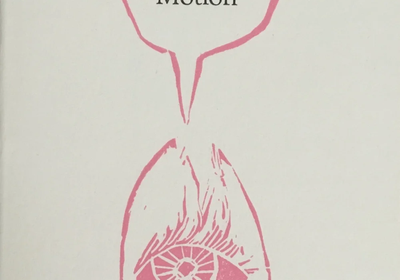
Poultry in Motion
Colleen Louise Barry
Factory Hollow Press, 2018
In an interview for rob mclennan’s blog, Colleen Louise Barry claims a love for writers who “capture the absurdity of life with empathy and humor.” This is not mere admiration; Barry is also one of these writers.
Colleen Louise Barry’s poetry chapbook, Poultry in Motion, is a compilation of observations and sentiments ornamented in an inexplicably sweet profanity. The opening poem, “Walking The Dog,” begins, “Man pees on entrance to park.” These words make the grotesque neutral. It makes sense: men do pee on park entrances. Men also pee on streets, statues, and the Blarney Stone. The casualness of the word “pee” is oddly captivating and an appeal that Barry carries through her poems. For example, “Hello” considers the removal and cleaning of the narrator’s Diva Cup® conversationally:
In a few minutes I’ll have to take my Diva
Cup out, and I’ll pour my period blood down the drain
of the bathroom my boyfriend and I share.
I’ll run the water a lot so that he can’t detect ANY blood
even though his facial hair shavings line the porcelain sink.
This is the first reference to a period cup or disc that I have read about, and Barry’s rendition is comically accurate. Her narrator considers the inconveniences of womanhood without being graphic, while still evoking that which is considered graphic: the difficulty of inserting period products; the cleaning of the mess; the hiding of the evidence.
Barry is more explicit in other poems. The second poem of the collection, “Used Condom,” opens, “On Christmas Day C and I drove past two people fucking / against a chain link fence at around 12:05AM,” which is both specific and decidedly not festive. Yet, crass details are balanced with social commentary. The seventh stanza of the same poem considers the expectations placed on women to become mothers:
C’s mom and many other women believe it is their duty to
have children
Some women even think it is the duty of all women
I’ve been told my opinion matters less because I don’t
have children
I’ve been told I’ll make a wonderful mom
This stanza is fascinating to me as a fellow childless woman because it evokes composure in the face of offense. Barry continues her air of neutrality via statement, but the placement and repetition of similar ideas have bitter implications. Child rearing has evolved culturally as a choice rather than an obligation. Still, women experience harmful and divisive expectations.
As much as Barry appreciates the difficulties of life, especially for women, the author does not dwell on them. Rather, Barry celebrates dichotomies. The poem “Dirty Seagull” is a whirlwind of irony centering on the gull itself, “belly lit up candle-like / edges sharp with the light and golden.” The seagull is dirty, but it is lovely. It is also beloved.
There was an old woman she loved the dirty seagull
She got used for a piece of bread
Both were framed by red bricks and white
splatters of defecation from above, from seagulls
Barry says the old woman was “used,” but this is a humorous extrapolation. Do we look lonely when we feed birds? Do we look sad? Or are we just gullible in feeding creatures that are capable of feeding themselves (and will likely have digestive issues as a result of our efforts)? This is an irony that Barry notes when she says the woman was “used” by the bird to the backdrop of “defecation from above, from seagulls.”
There is also a note on love in the poem’s final lines that reframe the previous absurdities.
Where there was a clear path it turns out
was a corner, a corner was a mask of love
A mask of love required for living
What is the corner? The corner might represent an unexpected outcome. The corner is also “a mask of love required for living.” It seems the path is the dead end of a hedge maze, and we had better make a game of it. Barry makes great use of the mask in her other poems. The narrator wears the mask of love in “Good Nature” by taking delight in the movement of a plant in the wind.
If you’re not having fun at this point
check out that roiling wild leaf
I am obsessed by its laughter
I am blown-away by its humanity
Barry also uses the mask to poke fun at oneself, as in “Hermit on the Loose.” The title of the poem is an inside joke that is elaborated on in its body.
I’m in the wet American meadow.
I’m the freak doing the frantic dance.
I’m asleep on the job.
Oh yes. There I am.
The narrator is a “hermit,” a “freak,” and a bad employee. Yet the stanza feels joyous. Barry creates this sense of exuberance through positive descriptions (i.e., “meadow” and “dance”). The narrator may be struggling, but there is whimsy still to be found.
Poultry in Motion crams a collage of obscure images within its pages that cause the reader to pause, like dogs wearing raincoats, used condoms in gutters, and grossly misspelled church signs. Are these things amusing? Are they concerning? Or are they simply a reflection of how things are: both beautiful and obscene?
Kate Macolini (she/her) is an emerging writer working on her first full-length manuscript. She lives in Maine with her boyfriend and their dog, Ray Ray. Her literary hobbies include reading nonfiction for The Maine Review, reviewing audiobooks for Kirkus, and meeting for gelato with her beloved writing friends.