I’m not an artist. Occasional sketches and doodles of mine wouldn’t usually qualify for the definition of art, anyway. Since childhood, I’ve held admiration and deep jealousy for skilled artists, who could devote effort to work I’ve always been far too lazy to persevere with. Most art, at least what I admire, requires some training and expertise that my limited pool of energy won’t expand to include.
Art at school felt closer to vandalism than creativity. I remember what passed for still life were displays of old furniture and decorations stacked in the middle of dirty classrooms, which, if not portrayed, were instead demolished and reconstituted as part of student projects. I was too fascinated by the lost or neglected value of the discarded objects to want to destroy them. Items such as old books and vinyl records were donated as useless junk to be freely used or abused, “for art”, which I guess isn’t something too many would complain about, and neither do I so absolutely, though the idea at least floats about that some of this abandoned memorabilia would serve a better purpose not being covered in acrylic paint or glued to a wall. I remember this impoverishing some of my creative verve for a while, at least enough for me not to want to do anything productive in art classes, and art remains (most of the time) something I distantly appreciate rather than participate in.
My favourite people are mostly authors. Mostly dead. The history of ideas, or intellectual history, biography, etc, is easier for me to access, and I found that my own experience of illness was better described in words than with imagery or music. As much as it is essential to life, I find it personally more difficult to understand heavy concepts in art, film, painting, sculpture . . . than if laid out in a heavy tome with the benefits of language. This is a philistine streak: my liking of art is often vapid, or ends at the surface world of appearances. Artists describe finer meanings and intentions, yet a cruel part of me, maybe a devil on my shoulder, labels this as a type of sanctimony instead of a hearty expression of a greater thing. I’d prefer to dismiss that judgment.
Anyone sensible who would choose to write about art or artists would do so while knowing more. Most writing about art benefits, obviously, if the author knows the subject intimately and can teach others. Yet there is some merit to my inspiration for this; in that an amateur view of art, or one learning to appreciate painting beyond base notions, is a psychology I want to explore—however indulgent. I want to finally rid myself of the lingering taste of philistinism, where the first instinct upon seeing a painting is no longer dismissive or superficial. I’m not always glib or cynical with art, but there is still part of me that suggests being offhand or snide, an annoying colleague undermining good progress.
Opposing the superficial devil, I have cultivated an interest in artists (interesting people I’d desperately want to be my friends), if less so the acute nature of their craft. Artists with an itch to create, and a talent to do so marvellously, are people I deeply envy and wish to collect. In another life, and with too much to spend, I’d fashion myself as some sort of salon host-cum-art curator, like a skinny British Gertrude Stein. Making up for that inability, I’ve tried to know artists and support their work, with my limited resources, and a few I consider good friends. Exploring my relationships with them (and exploring, broadly, my own prejudices) may hopefully teach me something.
I met Wendy online some years ago on a tiresome philosophy forum. Despite the aggravating company (many younger people interested in philosophy are insufferable), there were a few, either not so young or not so irksome, who made welcome conversation. Wendy has a background in psychoanalysis and critical theory, yet a life in academia, or as some esteemed scholar, was made infeasible due to neurological Lyme disease. Painful migraines, brain fog, short-term memory loss, and a list of other complex symptoms ensured that the scholarly life she deserved was beyond her. Worse, she’s American. Her complex health and dietary restrictions would be far easier to answer outside America, with accessible healthcare and less hidden nonsense in all the food. I should stop short of being some jingoist for European health and nutritional standards.
I spent many hours with Wendy (and her partner, Kooper) in Red Dead Online. This game provided a fake, romantic historical America for us to explore as classic western outlaws and vagabonds, roaming a beautifully crafted world of mountains, prairie, and swampland, on horseback, shooting bandits or resting by the campfire. We’d spend (too much) time fashioning our characters, changing their outfits, accessorising their horses or decorating our campsites. The game is a work of art, if only for the graphical design and fidelity. The assets are all meticulously appointed. It is a space where lying is okay. Even when the world is dirty, it is pristine and intended. This game became an impressive backdrop, the view above New Austin from Hennigan’s Stead or fishing at O’Creagh’s Run a substitute for the real thing, where illness and distance prevented us from trekking through national parks or taking a boat down the Mississippi. It is easy to argue that this experience is inferior to actually riding our horses through town or eating at a fancy restaurant in New Orleans. In many ways, it obviously is. Yet in the physical world, one can’t shoot runaway gangs without severe repercussions, and it takes far more effort to track them down, rather than have them predictably spawn near your location, and neither with the hassle of real firearms. My guns were customised with fancy silver Art Nouveau engravings (an expensive affair), and I’m not buying a genuine Krag-Jørgensen bolt-action rifle any time soon, let alone decking it out in filigree. If you are hurt in the game, you drink a tonic, eat some seasoned meat, and all is well—a dream. My avatar was a distinguished older gentleman with a great silver beard, dressed in a fine sage green ‘Londonderry’ collector’s outfit (while it should be Derry, the game is set in 1898; so we might forgive the naming—and the outfit is so swanky that almost no name would deter me). Playing as an older man in an online game is a novelty and a rare sight. It is fun to think of someone so long in the tooth flooring a gang of upstart youths. If we forgive me for being maudlin, it allows me to play at something else I won’t get to experience in real life either. I won’t ever grow a big bushy silver beard, and I won’t see my twilight years. Kooper dressed his cowboy in all-black (including the horse), and Wendy went for big hats. I’m still sore about how the game was treated (by its enigmatic creators), a waste of potential from one of the world’s largest game developers, practically abandoning its art for money or opaque reasons it will never communicate. Forgetting the lost potential, it remains a gorgeous world to inhabit for some time. I’d much rather meet around a virtual campfire, next to my dog and my horse, than sit in any conventional setting on a Zoom call. Video games can be pathetic or kitsch, and I’m more critical of their basic mechanics than most, but they may still be poignant. Playing wasn’t some shallow or throwaway experience, and the virtual space allowed us to mediate our conversation and eventually meet in person. Neither am I ever going to the real America—health and logistics make that impossible. I have to make do with a simulation, and America is best in the movies anyway. Art that is an interactive experience, shaped by our input, customised and tinkered with, is common enough to go unappreciated; in expendable games from a cynical, often callous industry. Yet imperfect people are always making good art. They make enough terrible art, arguably more bad than good, and may still provide a ground for our own superb moments. If something flawed can still overcome modern disillusions, then it is worth some respect. We can forget that art can be great even when its authors are inferior or risible, reading nonsense into discourse that isn’t there or supposing stupid meanings for their creations. We read our own nonsense into work as much as any banal or nauseating artist. But that shouldn’t always distract from the creation.
“Even in the midst of the most remarkable experiences, we still do just the same; we fabricate the greater part of the experience, and can hardly be made to contemplate any event, except as “inventors” thereof. All this goes to prove that from our fundamental nature and from remote ages we have been—accustomed to lying. Or, to express it more politely and hypocritically, in short, more pleasantly—one is much more of an artist than one is aware of.”
—Friedrich Nietzsche, Beyond Good and Evil
After years of digital correspondence, Kooper had the opportunity to research Freud (at the Freud Museum) in London as part of a study trip, which was the opportunity for both Kooper and Wendy to finally escape the US for some time and stay with me in Suffolk for a couple of weeks, between their artistic and educational adventures in the city. The weather remained sunny and welcoming throughout, and our previous communication, whether in virtual forests or in less gamified settings, lightened any awkwardness or discomfort. I met them, and I already knew them. From what I recall, Kooper enjoyed his time in the city more than Wendy did. Wendy’s condition precluded much tolerance of the dirt and pollution, even if she wanted to revel in the urban scene. Wendy enjoyed the countryside peace of Suffolk as I would. Cities are only good to visit for brief periods. I value nature and air too much for any urban life to be tolerable for long.
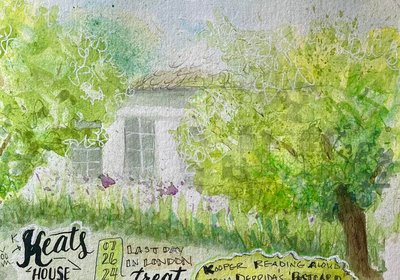
Unburdened by the constraints of long-distance communication, we could freely discuss artists and authors we loved. Baltasar Gracián, Montaigne, La Rochefoucauld, Nietzsche, John Ruskin, Raymond Aron . . . Wendy painted Keats’ House and the Freud Museum, always drawing something; a serendipitous purchase of a secondhand book allowed us to discover the Welsh painter Frank Brangwyn. We visited churches, Sutton Hoo, and quaint county towns along thin English roads that have surprised and inspired travelling Americans for years. The biggest ‘culture shock’ for them, I think, was the everyday infrastructure so different to the large and overwhelming American sprawl. Any customs, references, ways of speaking or other eccentricities they already knew through me or were not particularly surprising.
Infrastructure is always working against us, or at least its ceaselessly inept operation doesn’t help. Wendy lost all her luggage on the way back on a flight with no layovers. She found it again, though not before rummaging through the airport with little help from staff, who seemed to be unaware of their own surroundings, let alone the concerns of any passengers. I’m surprised anyone can fly anywhere without some debacle. Less a well-oiled machine and more an un-oiled beast. All the airports I’ve known have been undignified. Some duty-free chocolates and perfume won’t make up for losing your belongings or demolishing wheelchairs. Singapore is supposed to have a pretty one that I won’t see any time soon. I can’t travel by plane without the aid of oxygen. The more I hear about airports and their sins, the less likely I am ever to be in one again. Airports are like cities to me, with a type of intimidating intrigue that’s better appreciated from afar, and if I have to immerse myself in the mix, I start to lose my head.
As an aside, and I can’t help but include it, there’s something unintentionally funny about so many people passing through one space, the expectations of typically weary travellers, what is required of them, or what might suit their fancies . . . A friend of mine asked: Is there a more miserable, isolated existence than that of the single copy of Infinite Jest that resides interminably in the WHSmith at Luton Airport? That’s going to be stuck there for some time. By now, it is just part of the decor. While we all like to jest, doing so infinitely is probably unseemly. I’m sure the airport patrons must feel the same way and, as such, neglect to pick up the book. Also, I don’t think Infinite Jest is a book one picks up on a lark as a casual read on a busy day commuting. Reading such a tome requires intention. I never go around with such things as intentions or notions. That’s dangerous and possibly even vulgar. I instead wait and see what direction seems most appropriate at any given time. And reading David Foster Wallace is ill-advised in Luton.
I should apologise for my snobbery about city life. In many ways, it is a good recommendation that people live closer together in traditional, walkable urban centres, rather than cluttering and building on yet more pleasant land. Wendy and I share a distrust of cities, airports, and other urban bastions, as they can’t help but inflame our health, precarious as it is. It is old advice that the ill go for convalescence in nature, and I can’t fault it. Though I’m not going to roll around in mud or walk through nettles, I’m not built for that either. I’m aloof from too many walks of life. Cities have virtues, but I prefer them in paintings.
Outside the difficulties of urban life, relaxed in the country, I’d watch Wendy draw and use her small watercolour palette to paint brief sights and moments in her sketchbook. She would complain that whatever she had just interpreted to the page, whether a passing shot at old houses on the Aldeburgh coast, or the gribblies and faces in cathedral cloisters, on the move and transient, was inadequate and didn’t catch the scene in the way she desired. Yet from my view, or my mother’s, or from someone unaccustomed to artistic training or craftsmanship, the sketches all had a beautiful, fleeting virtue. If I wanted a replica, I’d take a photograph. Photography isn’t perfect; its pretence of realism is flawed, but the barrier to entry is lower, and for most laypeople and philistines, it will capture a satisfactory portrait of a moment.
We are easily satisfied, likely too easily. Wendy’s sketches were all immediately recognisable to me, and she was illustrating sights I was intimately familiar with, places I have seen countless times, where I live, that she was seeing only once, with a cursory glance. My own tastes favour inexact drawings and quick tracings. I love doodles and something brilliant created in a few minutes or seconds. Wendy underestimates her ability to impress others, but I won’t say her standards are too high. She can do more, learn more, while her previous forms are not unsatisfying or wrong. So-called better artists, in the popular imagination, get by on far less and with much less work.
Amateurs can produce great art, much as they may also produce great philosophy, or, more attuned, helpful and better effects on the world. With more artistic or philosophical training, one has a greater chance to produce great work, with more resources and experience at one’s disposal. Such a wherewithal, though, doesn’t automatically mean one will make the best or correct choice, or live the best life. Ask a professional philosopher to define liberty, and they may recall everything notable said on the subject over the past 2000 years, while an unprofessional bystander will rely more on intuitions and what’s immediately available in the culture. A trained artist is more likely to produce a worthy piece than someone who rarely holds a brush and who hasn’t heard of Monet. Yet amateurs can still surpass professionals; they may be better people, or give us a more interesting answer—the chances are just less so in their favour. Many of us know people who haven’t spent time in professional education but are nonetheless more ethically sound than expert scholars. A satisfactory answer relies not just on wherewithal and a scope of information, but on intuitions and prejudices. Sometimes years of study don’t reveal intuitive imagination. In this way, the layperson can be a ‘better’ artist, with the right mix of disposition, attitude or influence. Expertise matters, and education may help, but not always so directly.
We attended an event called Sketch Fest, with local artists and workshops along the River Deben, where artists learnt to paint water, boats, and birds in the picturesque setting. At the end of the day, many of the artists, amateur or professional, displayed their sketchbooks on a large table for everyone to peruse and appraise. Wendy’s effort, her first time painting boats and water, was well-admired. I overheard it mentioned well enough to be significant among the other books, with enviable company. Wendy was still doubtful.
I suffer from the same vulnerability: I feel ill, scant, and no amount of validation and respect, authentic and reliable, gets through the noise that says you’re not doing well enough for too long. The volume of cynicism is always greater. We are woeful, always trying to please ourselves while constantly sour at our attempts—as if under our own twisted despotism. We don’t cope with trying to please ourselves, and yet we have little strength, if any, to rid ourselves of the need. We hate our own flaws and also anything that might diminish them. If we remedied our complaints, then what would we have to speak of? All of it is too much for us; we will find discomfort whether we are quiet or loud. Few get rid of the mess, and those who say they do, all enlightened and at peace, risk lying.
Wendy’s art is the best refutation of my uncultured view. The craft and process of her art are partly an act of remembrance, a way of restoring memory and marking one’s life creatively when words fail, and when language becomes a lesser faculty. Though not remembrance exactly. It is not about being exact. The most important thing about Wendy’s art is the thing itself, the process, disorderly, self-referential, less so trying to declare something beyond reach, or less so an end; nothing so neatly packaged. The presentation itself, confused and upsetting, becomes more critical than a concluding message or something ideal. Wendy’s education in semiotics means there are always allusions, something more, and something hinted at, but there isn’t a definite article. Certitude is nowhere here. Attempts at an absolute (epistemological, representational, transcendental, rational) are sure to fail. Imperfection, cliché as it is, aware of its own unawareness, the permanence of imperfection, is the point. Or at least a point.
I’m familiar in my own way with occasional lapses of reason or complete perplexity, induced by illness or my strange constitution. As much as I value words and text most in explaining myself, this doesn’t mean I think they are the best way to do things: rather, it is the least bad or least incompetent for my needs, while greatness is impossible or beyond me. Wendy has to make use of a different medium, facing a similar difficulty. Most of the time, I am not coherent, at least in my own thoughts. Words have the benefit of time, reflection, and editing to capture a better view of my intent over speaking, which requires immediacy and is less accommodating of distractions. Sometimes it is complicated to talk because my health is always erratic and disturbing me, so I’m not reliably coherent or cogent in ordinary conversation. Most people are bad at the art of conversation and stutter, interrupt, or become overwhelmed, struggling to process words or access basic functions. No amount of reading, diligent training, or excellent preparation helps you when you’re overburdened and lost in the moment. A single misplaced word can throw a conversation off track. Whoever you’re speaking to gets the wrong idea entirely, and then it is all a mess. Anyone does well if they can slow down and engage in conversation less hectically. Much of the time, we have an idea in our head of what we want to say next and desperately want to get it out, rather than properly listening to our interlocutor. What’s most important can easily be lost in the heat of human interaction. Wisdom is often only recalled in hindsight. “Memory is often unruly, or stupid.” People are always passionate beyond and before their limited ability to be reasonable. Writing is better for deeper conversation as one has time to reflect over each choice of word, while in spoken conversation you’re under immediate pressure, distracted by objects in the room, or smells, or just being uncomfortable in one’s own skin at that moment; so I can’t be as eloquent or articulate in speech as I may be in writing, most of the time. Painting, or music, can express something where words are lacking, though it is still imprecise and false. It is familiar to us to pursue overwrought concepts like authenticity and individuality, especially in art. Sadly, the most common forms of this pursuit are cheap, corrupted, insipid or shallow and show an inflated sense of competence. This incoherence can be tragic or hilarious, but admitting incoherence should be more common. Often, I disguise how I’m feeling by acting whimsically or just being quiet. I find it hard to compose myself and act in a half-convincingly human way. I’m vitally awkward, weary, and never truly comfortable in any situation, even if I look content or unperturbed in some seemingly benign circumstance. This isn’t a rare sentiment, and yet we fail to acknowledge it—forget understanding or acceptance.
All this, I gather, is something I acutely share with Wendy. Her art tries, in some way, to express that discomfort and impossibility, either with a laugh and levity, or more sombrely, making use of the medium within her own constraints. If anything, Wendy’s particular condition, with much pain and distraction, only compounds this feeling and makes language, speech, or text and recording oneself in book form, even more onerous and tiring. I don’t want to give the impression that this is all so serious and grim. There is lightness and humour, which is best at regulating despair or misanthropy. Wendy’s work can be loose and subtle while also pointed and decidedly funny, whether it is a light, delicate watercolour of a garden, or a cunning joke about parasitic ticks. It takes little imagination to find solidarity. Wendy’s project to record her life with art, the journey, learning and watching her progress through different styles, finding what suits her best, has been a delight to see, and it is a joy to watch a good friend make their mark on life.
I first contacted Mette Ivers in late 2018. Part of my reason for trying was extraneous to art and more to do with her history, and history generally. I wanted to do some informal research on Albert Camus, and the chance to talk with someone who knew him was enticing. Yet the pretence felt rude, and I was wary that this might be a common invasion of her privacy. Mette is an accomplished artist and illustrator, at the time of writing still well and active at 93, yet, in an all-too-familiar story, has been overshadowed by the famous men in her life. For a while, it wasn’t so widely known that the ‘Mi’ in Camus’ private correspondences was her, where she was indeed one of Camus’ lovers. Romance is subject to much slander and gossip, and I sincerely wanted to avoid any crass or common insinuations. Later, Mette married the famous cartoonist Jean-Jacques Sempé and was again a footnote in an important someone’s life and not as much, at least in typical perceptions, a distinct entity one mentions without speaking of her past associations. I somehow commit the same sin, even when I’m trying to dissect it rather than maintain it. There is a routine feminist message here, one we take for granted, where a woman, however talented, appears second to a great creative man. Sylvia Plath became more renowned than her husband, in one of the few counterexamples, while a wife or girlfriend is typically relegated in some way.
Mette once told me about a time when some visitors came to her home while she was married to Sempé. Art from both of them lined the walls, and it was likely a privilege to see the home of two artists, with their work together, in a cosy, familial space. Yet visitors would ignore Mette’s work in the presence of the renowned Sempé, with his covers for The New Yorker and popular posters.
“When I was married to Sempé and had invited some friends home, they only looked at his drawings on the wall. Mine didn’t awaken the slightest interest . . . That’s how it is, Jake. Living or not living with a star, your work has no real value if you are a woman. For my illustrations I was paid much under the pay of a male illustrator, no more talented than me . . .”
Again, this is obvious or rudimentary, yet it doesn’t mean a lack of respect or gratitude toward talented men. My love for Camus and his work is undiminished, yet justice says we should expand the canon. It is a stupid impulse to dethrone the old guard of men for new faces. Genuine inclusivity means standing alongside giants, not just on their proverbial shoulders, and not misguidedly vanquishing them.
I read an interview Mette gave in 2019 and raised the subject with her. She knew well enough, and through real experience.
“You noticed that in the short presentation of my interview, it ends with the names of my two “great men” . . . I asked the author of this short presentation (a woman!!! (in 2019)) not to mention them. She couldn’t! No! It would have been so much better if we mentioned them, what a spotlight on the ant that I am! Misogyny is ancestral, thousands of years old, and women themselves are steeped in it. And the woman in the article loves and admires me!!! You know, Jake, I passionately admire the work of Camus. I’m not in competition. Sempé is also a valuable artist. But you yourself were struck by this quote from my prestigious private life. And it shocked you. Like me . . . My work is an independent and personal thing. You’re right, [Maria] Casarès is also flattened in her being by her relationship with Camus. We are all enslaved by this pervasive stupidity. Our leading men are like feathers in our caps . . . And endorse our artistic stammering . . .”
Too obvious. Only a fool might deny the truth. We live with a surplus of fools for whom even the most innocuous feminist tract is untenable. This isn’t even the fifth or sixth wave, or whatever wave we’re currently surfing. Unfortunately, this isn’t as obvious as it seems, and it is a mistake to think ideas are somehow natural or expected. An understated feature of the history of ideas, or ideology, is that thinkers and thoughts we believe we are consciously opposed to still seep into casual acceptance. Ardent anti-feminists will take as a given ideas from Wollstonecraft without interrogation or realisation, while still maintaining positions opposed to perceptibly modern or contemporary discussion. Most of us don’t realise what we accept or borrow from others, even if we oppose them. The idea that primary rudiments of feminist thought should be so obviously true is part of a Fukuyama-esque gambit or delusion, or to be more precise, an outmoded notion that good liberal and enlightened ideas are part of a natural teleology; organic, automatic, accepted and inevitable—with whatever opposition they have somehow being an aberration. This idea still infects us, or influences us (if we’re choosing a less aggressive verb), even if we reject it; such is its permeation through culture. We have faith in good liberal notions, their goodness notwithstanding, as if they would be common sense or clear and elementary moral standards. Instead, alas, we can argue things are true, but that does not make them obvious. We still need to litigate and make a case for something. I re-read Frederick Douglass recently, and by today’s standards his thought appears seamless, or so self-evident that it should go without saying. Instead, it still needs to be renewed. A superior assumption of obviousness is unlikely to lead to moral or political progress. Considering this, Mette’s point may not be new, but it needs renewed affirmation.
Besides that, I would correspond with Mette semi-frequently over the following years, at first asking questions about art and her history (she’s long enjoyed Voltaire, Montaigne—authors we’ve both enjoyed much since youth—Madame de La Fayette, Edvard Munch, numerable others), and eventually as a type of pen pal discussing the news and recent events as they happened in the U.K. and France. Knowing my ill health, she would send comforting messages that served as needed reminders and validation. Spend more time in gardens and find nature wherever you can. Without platitude or cliché, which become easy default modes, it is worth sending such reminders and finding the strength to keep going—especially during the tougher years of the pandemic, with many being less careful or concerned for vulnerable people (either vulnerable through disability, illness, age, etc), affirmations towards life were more necessary. It is also worth speaking with people much older than you. Right now, I am in my late twenties, foreboding as that is considering my condition and the dubiousness of my surviving long, and speaking to a nonagenarian artist gives a needed perspective absent from those closer to me. I find myself prematurely aged and irritably, if privately, scowling at bright young things taking life at a pace far too speedy for me to ever engage with. All generations are too mean to each other, and it is better to be more discerning.
Younger people have always seemed emotionally distant to me, or rather, their emotions are in a distant place that is harder for me to reach. I appreciate a wide breadth of humanity, though when I was younger, I would prefer to speak more at length (or more substantively) with older people. Youth is peculiar. I share youthful wants, or no lack of immaturity. Other common youthful desires (or vices, if we are rude) that require great energy and enthusiasm towards adventure are less obtainable. Being older doesn’t necessarily mean being sedate, but being sedentary is more common as we age, and I share a kind of elderly reticence. My limitations mean that being active and daring have always been less appealing modes of being. I can filter between social circles and niches with some ease, where class, age, or gender bother me less than they may others, as I don’t enthusiastically subscribe to any full membership. However, this means I’m more alone, or lonely, than happily on my own. Here is my prejudice: age should ideally mean experience and wisdom (which only makes it more disappointing to have lived long and not learnt much), so I value being older. If a group consists solely of the young and has no advice from other generations, then I’m suspicious, just as I would be in the opposite scenario for similar reasons. Ignorance and a failure to keep one’s thumb on the pulse are understandable failures with age. Youth is more often cocky, overzealous, rude, and while these positions are never absolutely unwarranted, and may be helpful, we get enough of them. I don’t trust friendships just as I don’t trust think tanks that are too narrow in their scope of ages. We are aware that age is used as power, with the old taking advantage of youth, though this is less of a concern for me. I have zero desire to punish youth or leverage it. I’m still young. Imagining myself as an older person only to wield power over youth makes me feel sick. Many of us comprehensibly, with just reasons, see connections between the young and old as exploiting vulnerabilities; as elder abuse or the opposite. All of this can colour our view with an intelligible yet obscuring lens. Still, I am peculiar. My own wants are innocent, yet it looks like I protest too much. I put so much effort into circumventing our concerns or fears that I seem odder than others who don’t investigate themselves. An innocuous, or even a healthy situation—a diversity of rich platonic friendships—looks off just for being uncommon. Its reasons for being uncommon are then not entirely spurious. After all the fretting, I have written extended paragraphs trying to justify something that should be common among a healthy civic culture—the sharing of knowledge and experience. Friendships with others much older than us link us to another world that is slowly disappearing. Let’s not turn this into anything perverse. We should put more effort into rebuilding communal and social bonds, rather than sequestering ourselves into like denominations. A narrower life of fewer friends (of every variance) makes us less creative as well as less ethical. For those reasons and more, it is worth being brave, sometimes foolish, and meeting a range of people beyond the digital simulacrum or our imposed limits.
In November 2024, I finally travelled to Paris to meet Mette. I’ve said before that I dislike travel. My worries could be assuaged if trains, train stations, and airports weren’t so aesthetically unpleasant and crowded.
The first place we went after meeting outside Gare du Nord was straight to Montparnasse Cemetery. I had been in 2018, and I wanted to make a kind of pilgrimage to see Raymond Aron and Samuel Beckett (again). A pilgrimage appears less significant without any religious affiliation or ceremony. Aron’s family tomb is Jewish (despite his secular, assimilated life), and Beckett’s is plain, almost unadorned. We weren’t silent or seriously reverential, nor solemn, meditatively contemplative, or upset. My French is terrible, and so we spoke in well-articulated, deliberate English; slower, making sure to enunciate and pronounce words with more care for Mette’s sake. Cemeteries and graveyards are worth walking in more often, as long as our sentimentality isn’t too tasteless. We somehow think that if we aren’t religious or dogmatically attuned, experiences like this are lesser. That they hold less weight, or that they are otherwise pointless without some apparently profound spiritual or metaphysical connection. This gives the committed too much credit, as if events can only have any significance if they are divine or extraordinary. We don’t need a great sense of spirit or communion to take pleasure or any feeling from events. Virtue, morality, love, wonder, grief, and the whole range of human emotion precede dogma, and this is true whether we are dogmatic or not. The religious are better for it if they know that their feelings exceed dogma or official direction, and that their world doesn’t shatter into nothing if they no longer hold one dogma or another to be true. Neither are the irreligious, wandering religious spaces, cancelled out of any virtue or significance unless we subscribe to the most inhuman and bureaucratic forms of religiosity, which border on being fascistic if they exclude others from human categories and experiences they know they should belong to. For the most extreme, simply exploring a church for artistic, aesthetic purposes alone (without prayer) is blasphemy. This isn’t something to recommend to believers, or anyone. Exploring the world can’t be a joyless, administrative, managerial affair, whether one accepts God or not. Anyone who relies too much on theoretical principles, especially incontrovertible ones, risks being lost, even fanatical, when those principles are shaken. Thankfully, for the less zealous, what’s beneath our lofty ideas saves us. We shouldn’t be left with nothing when principles fail. Anyone studious enough can render the world unobtainable and unknowable, easily upending theories and received teachings. Investigate life thoroughly enough and there is no security. Yet we aren’t all running around headless and damned. We survive as our virtues, our conduct, our inmost reasons, outlive later justifications. Reasons are invented to excuse our actions after the fact. I need not go further, I don’t care about God, and this isn’t the time for that sort of philosophical deliberation. I still care about feeling, life, intimacy, and wholesomeness, even when we are otherwise so lacking in knowledge, when so much is beyond us. Freud said that we will still face “. . . the difficulties which the untameable character of human nature presents to every kind of social community.” This isn’t a solely negative situation. Human nature, why we think anything worth seeing, why we visit gravesites without any promises of salvation, why we do anything despite death, and why we are good or bad at the bottom of all deduction, can be traced and dissected to a fair degree. But in the final analysis, it is beyond us, no matter our views or beliefs. We can say we believe something, really think we believe it, while doing nothing of the sort. What lies behind our motivations, any sequence, code or scheme, is irreducible, lost in the depths, and no amount of spiritual woo or scientistic pseudoscience will unveil it. We don’t give up life because we don’t understand it. What hubris suggests we can work it all out? If we somehow did perform the greatest act of genealogical or archaeological investigation into human action and found the sure reason why we do anything and magically knew our way, with all mental states reduced to formula, all life subjected to organisation, it is unlikely we would find it satisfying or even human. We suffer from exposure. We would be void, mentally and spiritually ossified. The lights in all our rooms would be lit, and we would hate it.
After visiting Montparnasse and thinking too abstractly about the limits of human understanding, I walked around Paris (or rather, I was pushed by my tired mother in my wheelchair, as walking around Paris would be much too tricky). My mum had never seen the Eiffel Tower, but we didn’t care to climb it (too long, too tiring) or view it so closely, with our noses pressed against the iron. Something she had never seen before could still be hackneyed and overdone, overexposed in tacky images. At the same time, sometimes even the most gimmicky-seeming landmarks have a good essence behind their exploitation. The object subjected to crowds isn’t itself debased, though its overcrowding and saccharine treatment by vain tourists is (often) debasing (at least to grumpy people like me, anyway). In these situations, where having a complete experience of a landmark would be wasteful of one’s time and weakened by the abundance of others, it is enough to view something from a distance, taking in the presence of an object without seeing how the sausage is made, where over-tourism or long queues make the experience a chore, losing its mystery. Maybe we just wanted to avoid a full-blown case of Paris syndrome, and we’re living in denial to preserve the magic? For some, being in the bustle is part of the joy—but I’m too impatient and fragile. In a world with fewer and fewer original experiences, or where quintessence is rarer and rarer, we have to find different ways of seeing sights (or sites) that keep the romance. Be that by avoiding the Hell of other people by visiting when nobody is around, or being satisfied with seeing something from afar. We don’t always have to be so close to something, although this works when the thing in mind is a tower visible from everywhere. The Mona Lisa is another question, where the sheer profusion of people viewing it, with no time to sit with the painting before moving along, makes appreciation more elusive. A museum with too many people is worse. I don’t just have a reactionary aversion to crowds; the time to study and value all the objects is rarer if things are too boisterous. Maybe I should be less misanthropic? Smaller museums, or those outside of visiting hours, maintain their charm.
Mette’s apartment was stereotypical, though in the way that’s appreciated. High ceilings, on the fourth floor of an old building with a tiny elevator shaft lodged between the spiral staircase. In her youth, Camus helped her acquire a picturesque apartment with beautiful tiles. The building’s age made installing an elevator between the stairs impossible, so she moved once the steps became too burdensome. Her newer apartment was still lovely. Her studio was also stereotypical, with tall bookshelves, canvases, paintings, spilt paint and easels. These spaces are familiar to me in the sense that they are common in media, while not personally familiar (at least anymore). Throughout my high school education, my form group spent time in the school’s art block, rotating annually between messy art classrooms. I didn’t like the smells or the rotating cast of strange materials and supplies stored there. This studio lacked the scent of dirt or of so many people coming and going—paint everywhere, disorderly, yet clean. The view from the window was also superior: a classic Parisian street rather than musty school grounds. Art on the walls surpassed most—subtle figures, drawings, portraits and illustrations. The small washroom had frames and little paintings too. My own downstairs toilet at home has two large paintings my sister and I made in nursery school on the wall adjacent to the loo. I have no idea what they are supposed to be, or what my four-year-old mind was thinking as it splotched large blobs of paint on the paper to watch them drip. I remember the easel was red, thick and plastic. I remember exactly where the room was, too, where I composed the Pollock-like piece. Art in toilets and bathrooms often features nautical or marine motifs: fish, shells, dolphins, and boats. I guess water makes the association fitting, while bathrooms being nautical is still not an immediate connection, but a secondary one. It all goes to the sea anyway . . . The best bathrooms I’ve been in had fishy motifs, crustaceans, or molluscs and clams. They’re comforting, blue and breezy, and somehow make the room smell nicer by a sort of spiritual association. Non-nautical toilets smell worse and are less welcoming. All this rumination comes to you when you piss in a new space, though it is soon forgotten when you get to food and socialising.
I hope to go to Paris again someday soon, eating from local delis and boulangeries. Vainly, I think I appreciate its history and ordinary life more than the average tourist or idle flâneur, even if I remain within the central arrondissements as a safe and casual observer. I still don’t approach having some fetish for dirty places, or some reverence for maligned cityscapes. The city can still make me shiver or cringe. Friends or family are required to guide me around or supervise my health. Mette is more storied company than most, and while it is maudlin or veering on kitsch to say . . . it is still a wonder to know someone of her calibre and her age, and daunting to think of our (limited) time. She gifted me a painting, a Mediterranean house, which reminded me of the houses I saw in Provence when I first went to France in 2018. Why such houses impress our imaginations is obvious. They have charm and warmth, and British weather struggles to recreate the conditions. A while before, she sent me a copy of Poucette by Hans Christian Andersen—a recent edition she had illustrated. I forgot where it was for some months as I had put it inside a box for its safety, as if locking it in a vault. I could understand, for a moment, why collectors with too much money hide the great art they buy (or squander it out of public view), fearing theft or damage. The book is now within easy reach, and the painting hangs proudly on the wall. Sentimentality is permitted.
I first knew of Riva Lehrer when her memoir Golem Girl was submitted to the inaugural Barbellion Prize. I created The Barbellion Prize, a book prize for disabled authors, in 2020. The underappreciation of disabled authors is surprising (given their historical prevalence, from Kierkegaard to Virginia Woolf, etc.) and then immediately unsurprising, given common attitudes and disadvantages. The prize was a hit, as they say, for the three years it operated before its current hiatus (as of writing). My own health meant being a primary administrator of the prize was not sustainable for very long, and I would need more organisational support to keep the prize going, which should be forthcoming. Regardless, the judges for the first year were enthusiastic about Riva’s memoir, and it helped her in some way, she admits. While the prize is in part a tribute and homage to the English diarist W. N. P. Barbellion, it also exists to represent disabled authors. That word is too common and overused for my liking, but my sensitivity to clichés or platitudes shouldn’t overstep an elementary point. Riva’s art, especially in portraits, has much to do with representation, with all its flaws and deceptions.
Riva told me that one of her “lodestars” was Alberto Giacometti. “Mainly his drawings are about the attempt to see, and the failure of seeing. That reality can only be glimpsed. A drawing like this, for me, is an act of severe honesty; the subject is built of notations, human vision at its most ambitious and most fallible.”
Riva has spina bifida, a visible disability, which means a lot when confronting a judgmental public that condemns so much at first sight. My own ill health is often, instead, invisible to casual or uninformed observers, before excessive coughing or inelegant interruptions pierce the fantasy. With all their variances, these conditions shape how we are seen, stared at (often and suspiciously), and how we portray others. Portraiture can be a subversion of how we stare and ogle at others. Riva usually paints fellow disabled people in ways a rude public can find disturbing just for their regularity, for being seen, lingered on, studied and investigated, and without venom or wariness. She shows love, tenderness, and an unsparing honesty instead.
Riva was casually asked, innocently by a friend, who should portray her in a theoretical film adaptation of her memoir. I half-remember a long, poignant conversation with her about it during one of my hospital admissions, and the layered contemplation the question provoked for her: about self-image, the perception of disability, logistical challenges and a weight of other concerns.
The motivations behind this reveal confused priorities that may turn crude or vulgar. Live-action film is typically, without considered thought, deemed the pinnacle of artistic expression for any story or for epitomising a person; despite how other media show strengths and weaknesses that may pay a better compliment. A book, a radio show, a stage play, music, animation, a video game, all these are different modes with different specialities, different capabilities, with distinct features that mean a book can do what a film cannot, a film can do what a book may find unworkable, with further determinations the further you go. Video games are inherently interactive and so may tell stories and exploit mechanics that cinema cannot constitutively provide. Yet, the implicit prejudice in favour of film and being cinematic, for all of cinema’s fine qualities, means games (or at least the most expensive ones) still often strive to be much like films but with some minor interactive elements. In our hierarchy of art, we place film above all else, particularly live-action film with all the trimmings. That a 2D animated television series can portray action or nuances that a 3D film cannot, and vice versa, and that a book can do what a game could never do, and vice versa, is barely considered in popular culture. Even if we can note obvious differences, we still hold on to this creative pecking order: film is best. The incessant drive to remake, remaster, and redo practically anything in a film adaptation betrays not just the economic concerns of film studios and producers, but also key aesthetic notions that have diffused through culture. The bias likely derives from a jumbled mix of preferences for realism; it is not my place to dissect all the reasons why; we can simply take notice of it. Do we really, really need a Golem Girl biopic film? Memoir captures life in ways a film can never do. Rather than a myopic hierarchy of artistic media, we need a filter for what each does best or not in each case.
The desire for adaptations can be benign yet also perverse. Each time I see a biopic adaptation of real life, a celebrity biography made for television, a war film, a historical epic, or the life of Miles Davis, I feel something minimally uncomfortable, or at least, even in the most commendable and awesomely directed cinema, that something is wrong here. Paintings portray real, non-fictional events, as do books, yet many film biopics have a particularly lurid or disturbing effect, something that can be cheaper or more profane. Any art can be uncomfortable, which isn’t an argument against it, nor for its tighter regulation, but I still harbour this tense suspicion. I think in books, or paintings, there is a greater licence in non-realistic and imaginative interpretation, which can somehow be fairer to real events, without the photorealistic pretence. Yet with an added pretence, an added façade, showing real environments while telling a fictional story, an eerie sense we can feel in the portrayal (or misrepresentation) of real things can be disarmed. Film can be brilliant and surpass these impressions. Yet, considering the dramatic incitement to have recent events and people shown in this way, a way considered best for inclinations towards realism (a simulacrum of realism of course, always slightly off), with how we so habitually crave to dramatise recent crimes and recent deaths, this isn’t always an urge I think is healthy or appropriately adjusted to coping with our affairs. Not that it can’t be, I’m always equivocating, but this is my prejudice. The appetite for these representations, so sensational and explicit rather than not dressed-up for prime time video, not in showy images, where we really must see something, is not always a good way of seeing. To adapt something means we make unkind choices, careless additions, and omissions. We delight in some things in a way that’s untoward, or doesn’t render life, often frightening, tragic or disturbing, in a way that gives respect or better appreciation. I can like something gaudy or even tasteless, yet I can also feel different things simultaneously. Great art can still leave a wearying impression, making us doubt its purpose. Let’s be short and less verbose: a biopic risks being disrespectful. And while anything can be callously produced, I’m more often feeling this in the presence of a screen than on a page or canvas. I won’t call on anyone to stop anything, but the sentiment still haunts me in some unsure way.
My friend Kooper reminded me: “. . . the medium of film is unlike other media in that it can produce a more uncanny effect by making present a past reality and making certain audiences feel like they are witnessing the people and events in question themselves. Film is akin to dreams in its ability to trick viewers into hallucinating reality. All film is based on illusion, but that’s not to say other media are more reliable.”
This sentiment is likely part of my trouble. Film has the potential to be more uncanny than other media, I’d cautiously say. It can cross greater boundaries than, say, photography and encourage more blithe engagement. Then consider how many bad, multi-million-dollar biopics there are of important figures. If one is wary of being misunderstood and misinterpreted, then the possibility of being crass and impertinent is magnified. Riva’s intimate worries about poor film representation are shared, while I’m sure I’ve gone down a mental spiral beyond her primary concerns. Pristine, unfiltered understanding is impossible; dull attempts to strip away and get at the essence of something can be tragic, funny, or ridiculous. Still, we at least don’t want to be presented in such a poor light, or so uncannily, that others get a violently wrong idea and we start to feel sick about ourselves. We know some things, terrible events or the inner workings of our private lives, are beyond the reach of art: whether they are great works of art or not.
“. . .we watch television programs and we say: ‘Sorry, but it isn’t it.’ And when we are asked: ‘But what is it?’, we find ourselves unable to respond. What we really wish to say, what we feel we must say cannot be said.”—Elie Wiesel.
I’m reminded of Agustín Fernández Mallo’s objection. The objection to writing, or painting, or film about intimate subjects isn’t necessarily aesthetic or moral. I don’t feel prudish or morally outraged over sex, war, death, or complex inner lives shown in art. The art can be technically amazing and finely crafted, even. I instead sense a residual inadequacy. “. . . because it seems absurd to me, sex is like dreams, it cannot be ported into the representational mode, it never comes out well on the page, or on-screen, in either place it ends up untrue, ridiculous, or naff, or trivial, or laughable, or childish . . .”.
There might be some merit, if not total and never absolute, to the idea of where one cannot speak and remaining quiet.
One of the more practical concerns in adapting Riva for the screen is choosing the lead actor. Employing non-disabled actors for disabled roles isn’t absolutely bad, or impossible, or necessarily wrong, and by many reckonings is easier, but instead becomes an issue of labour rights or access to employment. Particular disabilities leave one with less energy or time to do anything, and logistics alone can make employment difficult. However, it is still true that disabled actors are denied work they could plausibly do, where less consideration is given to structural disadvantages that could be conceivably mitigated. Yet a disabled actor who fits Riva’s appearance may not exist. Do we employ CGI to make the character more alike, or would a more surreal route, with Riva portrayed as a fantastical monster and with exaggerated practical or digital effects, be better for a hyperbolic view of others’ warped perceptions? Or does that risk obvious offence? We can rest on the idea that it is okay or unobjectionable after enough finesse and deliberation to represent something. With any moral concerns eased, we still cannot say what must be said. Riva reminded me of a complex, delicate reality, where a proposed biopic representation of her would always be insufficient in some way. We are having to measure various practical, ethical, and aesthetic demands that have no clear, impeccably appropriate answer, and we will always have to make some form of trade-off or uneasy compromise in representing her, or in the finer portrayal of her story.
My connection to Harriet Memory is slightly confused—or, fittingly, my memory is in question. I knew her vaguely through mutual childhood friends, and I discovered her art relatively late. Everyone I have written about previously is distant or abroad, and I dislike that I don’t live in some alternate world where everyone is closer to me. So an opportunity to know an artist who at least lives in the same country is helpful. There is no shortage of local artists in swish middle-class art galleries near me, yet I still struggle to meet strangers, regardless of the fortuitous connections I’ve somehow made above. My tenuous connection to old acquaintances and a couple of recommendations made saying hello less inconvenient or laborious, as a sort of stranger is at least easier to speak to than a total stranger.
Unlike with the above artists, I am less familiar with her or her work, though this provides an opportunity to explore how art can foster new acquaintances, or rather, arrange renewed links with one’s past through mutual connections. Being so local to me also means access to shared national and regional knowledge, and I can work on building greater local roots instead of distant relations with people I can so rarely, or maybe never, meet. I’ve said already, illness adds a fundamentally anxious and unsure dimension to any physical interaction. I always want to make new friends and cherish friendships as essential to a better life. Somehow, I’ve found this easier with people terribly far away than with people on my doorstep. Aristotle said friendship is “. . . most necessary to our life . . . no one would care to live without friends, though he had all other good things.” I’ll accept his authority (at least here). I’m long tired of society’s undervaluing of friendship as an institution, where it is by some means considered, on some unimaginative hierarchy of relationships, below the upper tier, lesser, or somehow optional. This is unthoughtful and frankly boring. We should be more open. Besides my own weariness or lack of confidence, there are sociological reasons for our poor form. It should be simpler to reconnect with old friends with the ease of new technology, yet without an organic or apparent reason for doing so, this is uncommon. We’re more likely to be suspicious of being sold some pyramid scheme rather than think someone innocently wants to say hello after a long while, if contacted out of the blue by some half-forgotten school friend. This is an indictment of modernity and its disenchantments. I share dozens of mutual friends with Harriet from childhood, many of whom I occasionally wonder about in an offhand way, or I’d be happy to encounter randomly in the street, yet doing something as straightforward as sending a message to them, asking how they’ve been doing since we last spoke, feels clumsy and awkward. Past friends remind us of youth and, consciously or not, of disagreeable memories we’d rather forget. Yet one can’t grow intellectually, emotionally, socially, without going through odious incarnations, if we’re quoting Proust. I don’t house any especially awful, let alone any criminal or repugnant past mistakes, but for many people, youth is at least a bit embarrassing or regrettable. Years pass, and most of us surely become very different personalities, hopefully wiser and more worldly, while we can simultaneously reject our past and acknowledge its necessity for our development.
I hold far less value in the idea of art being a lonely activity than I used to. Stereotypically, art requires, or has been made within, conditions of solitude and distance from others; with the fear that company or too much engagement with others’ art will impress upon one’s own work. I find that the recent books I have read seep into my vocabulary. I then involuntarily adopt them as my own, sometimes with a keen memory of their source, though often in a haze where a secondhand phrase becomes my own in a process of (wilful or sincere) forgetting, or oblivious osmosis. If I am not careful, I become a parrot, but then it is more important, in my mind, to be honest about our influences and not be ashamed of being infected by others. I first read the word ‘verisimilitude’ in Kafka. It would be graceless of me not to owe him.
More importantly, I would be a far weaker person, intellectually, if I didn’t have, say, the articulation of Leszek Kołakowski on the fluidity of ideological allegiances (similarly, aesthetic allegiances), where there is a recognition of being ideologically beautiful (not a phrase of Kołakowski’s, although fit for our purposes). We can think of ideology negatively, as in dogmatic and intransigent, extreme politics, but ideology is more: not a set of boxed and controlled conceptual categories, certainly not a dull list of policies, but a loose sense of ideas and dispositions, epistemologies and emotional inclinations, that float about culture and history, fluidly and pluralistically, that influence us whether we like it or not. We are all, in some way, more conservative, or liberal, socialist, anarchistic, authoritarian, or of any other lineage than we know or acknowledge. We are made outside of our control, all implicated by any idea with any power in our culture. Fittingly, speaking of unconscious meanings, we are all to some degree Freudian in the way we frame and think about the mind, personality, beliefs, desire . . . We are, in some measure, as I have said before, emotionally Fukuyamaean, whether we are intellectually well-disposed or actively opposed to such notions, as ideas penetrate culture (and us) beyond our conscious will. Individuals don’t often invent ideas; they give names and shape to what already exists. This applies just as much to aesthetic bias or affect. Images, less articulated than considered beliefs, hold sway over us beyond our reckoning, and this doesn’t have to be negative or some imposition on our lives. Artists can sometimes vulgarly express a wish to be alone and special, as if their work must stand on its own or must be created without interference. They envy others as much as the talentless envy them, and can grow susceptible to a lonely arrogance. I can’t discount the idea that solitude, a lack of engagement, distance, and rejection produce masterful art. Life requires relief from the presence of others, even forgetting other lives. Yet I am less attracted to solitary living or solitary expression as I once was (and when I was more committed . . . there was a youthful narcissism that framed this). Graham Greene once said that a writer engaging with other writers discussing the craft of writing, as much as fellow writers were his friends, was a masturbatory act. I think this is unfair. We want to remain our own personalities, think for ourselves and stand unassisted, but we can’t so seamlessly reject other lives. If we don’t want to be in full agreement in an aligned community, we should at least aspire to a more commodious living. Misplaced pride makes us not want to owe others, and it is foolish to want wisdom all by oneself.
It is not the case that I am interested in literally collaborative art, where two authors or two painters write in the same book or share the same canvas, but I am less moved by the image of the artist in solitude, which becomes a type of tedious affectation or hackneyed banality. All of this text is in some part a lonely experience, as writing so often requires solitude and quiet, physically on one’s own and without the immediate distractions of others. I am nonetheless more receptive as I age and brood over my life to a shared, even mawkish or saccharine, corny or cheesy, solidarity and exchange with others when viewing art. This is a departure from my usual temperament, which is poorly socialised and self-pitying.
Getting closer to the point, the above extended deliberation comes from envy. Harriet works with Art Safari, an organisation that hosts exotic painting holidays and workshops, as well as the aforementioned Sketch Fest event I attended with Wendy. As someone without any painterly talent, I enjoy a secondary fulfilment in being surrounded by skilled painters, but also jealousy and resentment at my own inability. If I am not careful in mediating my emotions, then the artist’s life, viewed from the outside with an idealised filter, glorifying in the vision of the artist’s retreat and one’s profession, let alone their vocation, being art . . . hazards becoming some flashy ego ideal one invests in to escape reality. If one is less privately aware, we can succumb to fanciful imaginings in which another’s good life makes one’s own more tolerable. When I wonder, either committedly or off-handedly, what my favoured life would look like, what I would do without limitations or if not prevented by illness, my wish resembles these creative lives: art as one’s profession, venturing to faraway places to visit elephants and awesome landscapes, and not just painting for myself. I’d like to teach, or at least advise and guide others. Outside my imagination, I lack the knowledge and the stamina to learn, or I am sluggish, so I make do with knowing others, or even voyeuristically appreciating them. Jealousy is often bitter and rarely elicits pity or sympathy. Yet, if it is recognised, interrogated, tempered into shape, and aware enough of its own ill, refusing to give in to mean temptations, then we can see that it is born of appreciation. Our self-interest doesn’t need to be selfish. It can evolve into gratitude. Many artists will be quick to tell you that their lives are not romantic, picturesque, or calm, and that they struggle with the same obvious afflictions and more that we all do. The tortured artist is such a common stereotype that it becomes irritating. I have less time for the morose, alcoholic or degenerated artist, with their life of woe. If I am careless, then I grow judgmental of pretentious musicians and their silly clothes, or their excessive pageantry, or their tacky lyrics. I shouldn’t be so rude. I admire painters more for what I see as a lesser pretension, but then that can be stupid of me; as if painters don’t behave just as wildly, with as much potential for sanctimonious drivel. Paint is poisonous; don’t get too close. Thankfully, there are enough good and great painters (and musicians) that we can ignore the bad ones (as hard as that can be), and my ideal picture isn’t totally divorced from real life. I’m rude about the morose artist as they are closer to my own natural disposition, so my lashing out is also a form of self-dismissal. Or I have consumed so much depressive art and literature that I begin to lose sight of its merits; its familiarity rears contempt or apathy. The art, or specifically the paintings, that I approve of most don’t resemble my ordinary emotions. As well as quick sketches, I gain the most enjoyment from paintings of animals and the natural world, in happy settings or avoiding bleakness, which I guess is why Harriet’s work is so appealing to me. It shows a life that is decidedly not mine, and reveals a simultaneously bitter but gracious aspiration.
I gifted Wendy one of Harriet’s paintings, a delicate piece of a dormouse. In doing so, I wasn’t just being nice. I was trying to somehow connect the artists in my picture library in the outside world, as well as hand a local present to an international friend. In truth, I struggle to say more without sounding banal and cloying. I can be cynical; we love things selfishly, as they relate to us, and if I prefer my friends to myself, then that aligns with my own tastes. We are self-regarding, even vain, and without that preference, we wouldn’t be true.
I have a small collection of books about friendship. It has been a repeated motif in the earlier sections, and it is through friendship that I prefer to explore art, rather than alone, despite the art I partake in (if memoirs and essays can somehow be considered art in the same sense as novels or fiction), being, again, a mostly lonely enterprise. The Norton Book of Friendship is prized on my shelf. When I enjoy paintings of lonely figures, such as Caspar David Friedrich’s classic Wanderer above the Sea of Fog, I like to imagine myself just behind him, accompanying him on his journey. I engaged with that painting more significantly after first reading Ecce Homo by Friedrich Nietzsche, my 1985 Penguin Classics reprint of which featured the wanderer on the cover. Indeed, though I wouldn’t recommend this to anyone new, it was the first work of Nietzsche I read as a young boy (I loosely recommend reading The Gay Science first and being of a more experienced age to appreciate him better, and avoid clichés or immature caricature). I read as if he were in direct conversation with me, lecturing as an older man, and with me surely missing all the nuance or subtext without good guidance. Through the solitary act of reading, I felt a type of communion, not of physical community, but of shared associations and tangents. I rarely get to speak about Nietzsche, or anyone I appreciate more (Montaigne, Aron, most recently Georg Christoph Lichtenberg, etc) in a way that isn’t me self-interestedly monologuing. Art, or scholarship, is better in dialogue with friends.
I’ve written about friendship and its importance, how it is undervalued, and the difficulty of making new friends (physically, not through a digital facsimile of human interaction). Yet it doesn’t matter how much I pontificate on the matter if I’m useless at doing anything practical. Some of this isn’t my own fault. There are social forces that contribute to our poor ability to communicate, maintain, or start friendships, and these forces are somewhat beyond individual whims. Yet we still have some responsibility to be ethical humans and try to be good friends with one another. My own hankering, or aesthetic ideal, is a robust group of regularly seen friends, all with a type of creative brilliance that I can bask in. Besides sociology, it is my own biology, a substrate of discomfort, that prevents me from being sociable. For my whole life, I’ve felt I’ve had to pursue or chase any relationship, with little coming to me on my own, with poor results unless I put in some (rather emotionally arduous) work. This isn’t an unusual or original thought. Maybe the price of admission for some to keep friends means putting in this effort, though it is still tiring. We may have ‘low maintenance’ friends who we barely talk to, but can easily rekindle conversation with after a long absence. Life is busy, and this dynamic has an implicit understanding. I love lots of people dearly, but I don’t get to see them often at all. Yet we also need high-maintenance friends, people who call after us regularly, who check in most days, and the level of stamina these relationships require is not appreciated. We quickly spoil them. The best life is impossible without friendship (as I’ve already reiterated), and I’m heartened by lifelong friendships, or deeply envious of them.
All this said, I still hold a fundamental weariness, or tension. I want to be social and immerse myself in social situations, but my health often fails. I’m never at ease, which makes everyday interactions difficult. I become far too eager to pursue some form of reciprocity, and when effort isn’t returned, I feel cast astray. I want to enjoy varied, deep friendships with a wide breadth of humanity; old, young, men and women, yet what we may call ‘common dynamics’ or popular notions about how people are (or what they are supposed to do) make this harder. We start believing in intentions that don’t exist, or we lack confidence and become distant. The now-ubiquitous ‘ghosting’, as the youth call it, which hurts more because of the ease of communication, happens among lovers or friends, and we can’t find a more honest approach, which might be culturally unavailable. If you try to break the taboo, you come across as either too earnest or leering.
We are ill at ease with this paradigm, as it were, and we recognise, at least in part, that this unfriendly behaviour is a vice. Yet the answer to the vice is just as terrible, as it requires a type of uncomfortable honesty or self-reflection. We cope neither with the discomfort of our afflictions nor with the task of curing ourselves, in other words. We are wretched, as La Rochefoucauld would say. Let’s not be the sort of “nose-snuffling, cynical man”, as Barbellion scolded, who takes too much pride in a kind of depraved knowledge, as if he has laid bare human nature and revealed all as selfish . . . That’s too easy; we can be cynical about cynicism. Still, and yet, we see follies. We invite drama and slander; we wade willingly into a mess. I know few who have performed enough interrogation of either life or self who really take lessons to heart, who know when to be loud or quiet, to be moderate or immoderate when it best suits, who know how to respond always in the right tune or key. Anything I say sounds dissonant. Put me in any situation, and I’m half-dazed. Intelligence doesn’t work; imagination is scarce. Centuries of art and literature, all studied in the finest detail, and the most banal acts of community, our constant subjects, are still insolubly awkward. So much is strange about how we spend our time. As we struggle to do anything, we take the path of least resistance, which means carrying on as we were, satisfying nobody. We can always say we are too busy and use that as an excuse to keep to ourselves. We may well be too busy, but it comes at a cost. We are all very busy working away and with less of a good life to show for it.
Most of us, if we interrogate our wants and desires, find ourselves in contradiction. Either side of our contrary desires is true, simultaneously, where we affirm and reject our inclinations or prejudices all in the same breath, or believe two things at once: entirely possible, not wrong or unnatural, yet still unsettling. I write again about friendship, and I concur again with La Rochefoucauld (who is becoming more and more of a touchstone of mine—I should be careful) that true friendship can be harder to find than true romance. Friendships are essential to a good life, I repeat ad nauseam. And yet there is still something I must admit to myself if I want to be honest. All the above is true, I value friendships in many cases more highly than romance or eroticism, while I am still a desperate, yearning and laughable romantic. I adore women, beauty, and all the superficial elements of female presentation as much as I do our richer, inner lives. Women captivate me. I imagine myself helplessly in their hands, fawning and slightly pathetic.
I don’t put myself out there, in the worldly sense. I don’t talk to strangers very often, and I certainly don’t proposition anyone randomly, without a proper reason. My life is too alienating, or I am too self-defeating. Being ill prevents internal comfort and prevents me from accessing the type of effortless surrender, rather than foolish seduction, that I would prefer in any social engagement. Friends are difficult enough. The whole artifice, the imposed way we are determined to engage with each other as sexual beings, or lonely souls seeking common cause, is somehow daft, absurd, atrocious and frightening. And then there’s the fact that I’m failing, as in my health is ever on a downward track. Trying to convince myself that I am a person worthy of romantic love feels silly when I can’t do much, and my life is too precarious to live in a substantial union.
Anyone describing the usual romantic troubles common to so many of us finds themselves met with rote responses and dull clichés. All this has been said before; why repeat it? In some way, I blame other men for making love a more treacherous affair, being so hurtful and vulgar. I can’t imagine myself as a woman wanting men to approach me, given what many men have to offer. Regardless, I can’t be stuck with sociological explanations or personalities beyond my control. A crisis of men (and fake solutions to male ennui) isn’t something to get into now.
I am still utterly useless at social intercourse, let alone any other. Trying to engage with life, talk with others, and form meaningful relationships means overcoming a range of technological and social obstacles I have little time or energy for. We have not just outside machinations but my dreadful id to deal with. If I begin to find a particular woman enthralling, I’m soon lost. My time is over-occupied by daydreaming (and this sounds like all the regular cant—all the regular, overplayed talk), and with little way to organically, without some degree of insufferable discomfort mediated by clunky, inadequate mediums, speak to anyone with clarity or finesse. I value clear, proper communication. I’m still bad at it. So much of what passes for communication now is a shortcut, or a type of electronic cheating that renders real speaking as something not at our disposal. If I try to say what I want more severely or in detail, I may be seen (justifiably) as some indulgent freak or a tactless buffoon.
This contemplation looks tangential and possibly irrelevant, yet it is a type of study of aesthetics where we might find a better answer, or better presentation, for all these difficulties that some book of rules or analytical disquisition is unable to provide; too sterile and robotic. In art, we can reach for an attentiveness, to try and grasp meanings and circumstances in a way that isn’t always immediately understandable to us, much as a poet can express something unconscious and not just of their superficially intended purpose. I don’t care for art or aesthetics as some successor to religion, but to attempt towards a type of wisdom, or perceptiveness, that isn’t found elsewhere. Beauty isn’t just about looks; it means a beautiful life. And a beautiful life is harder to come by without the wonders of art as well as the wonders of friendship, in tandem, where we can try to divine the world. I memorised a quote from Ford Madox Ford’s The Good Soldier as soon as I had read it, and had the temerity to have it preface my memoir. “We are all so afraid, we are all so alone, we all so need from the outside the assurance of our own worthiness to exist.”
All this internal conflict is a vice; the overcoming of which requires greater discomfort, or spirit, I fail to attain. Part of me then wishes to give up on love, or romantic feelings anyway. They cause so much grief in their failure to be satisfied that I can half-convince myself that stoic asexuality is possible. But then I’m only lying to myself, or acting ridiculous. I can’t help yearning in the morose, one-sided, sickening way that I do.
I imagine a long life, family, a home, love, things I see among my peers that, while not easy, still appear as regular, ordinary, normal. I envy them.
None of my artistic friends here has wealthy patronage. Rich people used to be patrons of artisans and the arts. They would pay for bespoke tailors and fund opera houses and libraries. I don’t wish to be romantic, but rich people no longer do this. Arts and craftsmanship are now preserved, barely, by a niche, depoliticised middle class with eccentric interests in artisanal goods: clothes, fragrances, architecture, or whatever else. Class, in the old definition, patrician elitism, is more obscure and deeply impoverished. Rich people now don’t have ‘class’, or style. They don’t rely on the best artisans to preserve their prestige or invoke status. They favour gaudy brands whose prestige is in the commercialism of their name, fashion in the worst sense, no longer talented or exceptional. For all that was wrong with ‘old money’, much of the arts relies on elite and moneyed sponsorship. And if the rich don’t care for this, or don’t know of it at all, then valuable craft and expertise dies—without sustenance.
The political right used to be home to elites, meaning cultural and intellectual, artistic elitism, or snobbery. At least the snobbery had talent behind it. Now, elites are rich but vulgar, dress poorly and have no taste for arts or culture. And they wear silly hats. Simulated poverty became an expression of authenticity that insults the poor, as if their aesthetics were appreciated by the wealthy but not enough to remunerate them financially, and gives the rich a reason not to invest in high art. Poverty is destructive, undignified and cruel, and it is better that we properly reduce both poverty and inequality. When the ultra-rich play as poor people in fancy dress, it gives credence to the idea that being genuinely poor is somehow authentically excellent and good. They romanticise poverty and, in so doing, make poverty, to some degree, not a concern to alleviate.
If one’s primary goal is to make fatuous amounts of cash, then we won’t make the best art. The best art, shown historically, requires spending an extravagant amount of money you won’t get back—at least sometimes. The most extravagant art in history, in temples, churches and museums, didn’t see a swift return on investment. You can make great art with little money, but I’m no rote leftist, and it is rash to say art doesn’t need large pockets. Trade and business, the patronage of capital, gives us the opportunity for spectacular art that will live in posterity, yet this is only the case if we have other concerns besides efficient money for its own sake. Without religious, social, or cultural motivations, if money is primary rather than secondary, then art is depreciated. Old capitalists, even old feudalists and kings, gave us great art. Now they don’t. Today, the world’s richest are enthralled by finance for its own sake, or by power, but without regard for the public good. They are perverse, profoundly selfish, artless, neurotic technophiles. Past times were brutal and anti-human, yet they still provided us with elite patronage of the arts and well-funded craftspeople. They are brutal now, yet with fewer and fewer aesthetic justifications.
All of this meandering writing is an attempt to uncover a connection, or even create a new mythology for myself. We lost mythology, though I never really cared for it. The past was never so unclouded, and we have always had delusions. Today’s superstitions are much like the past’s, with whatever differences in artifice or detail, and new delusions are invented daily. The past appears irresistible but offers the same lamentations we have now, while we’ve developed a greater vocabulary for our complaints. It is probably better to realise that past figures felt a similar level of dire trepidation for the future as we do now, and I might (intellectually) lean that way. Yet, the speed of current developments gives anxiety a new sheen. Returning to a kindly pastoral past is something a few of us act out, in affected ways, with various self-flagellating restrictions on technology—a type of anti-science-fiction. Our technology, obliged rather than optional, speeds along at a rapid clip, offering uneasy dismay more than any real excitement; never mind pleasure. Addressing any of that at a societal level is beyond individual whims. Technology doesn’t reverse itself. We can maybe react to it healthily, with the growth of local roots and community, and, with luck, avoid the tasteless flavours of nostalgia or desperate hankerings. The concept of renewed community or revitalised friendship risks becoming a therapeutic fetish, where, instead of real community, with all the honest ideals of support and social sustenance, our failure to mediate conversation correctly (despite the utility of modern communicative technology) means we fail to attain anything. Our ideas about love and friendship remain as images, empty simulacra or aloof possibilities, where the failure to organise anything properly results in indulgent dreams and resentment. Localism, if it is some -ism, can be reactionary or fascistic, closed to outside help, insular and rude. While we fear the impacts of ecological destruction or worldwide trends beyond our ken, and may want to retreat from the wider world to our local sphere, looking inward, to our nearest neighbours, it is of little use if this becomes a neurotic fantasy. Any idea can degenerate into terror. Yet I don’t wish to be some herald of catastrophe, as much as I dislike claims of salvation. Hyperbolic exaggeration is a type of lie, and still a lie even if it leverages truths. As much as the world seems predictable, with all the data and balances on offer, history still offers us fewer settled convictions—historical tendency notwithstanding.
The truer, personal root of all this trouble is my own expectancy, not just wider expectations. I’m closer to death and clumsily reaching out to past acquaintances, finding any connection I can while anyone else is too busy or unaware of my indulgences. My fixation on art, or my attempts to appreciate it more than my cynicism allows, material and human in the basest ways, is a last-ditch effort to find meaning or solace when anything transcendental, metaphysical, or mythological seems unconvincing. I’ve previously called this a ‘material sensualism of friendship’. I’m sure it would appear just as unconvincing to those who believe in elevated positions I reject, yet the alternatives of nihilism or cruel misanthropy are worse than unfulfilling. I oscillate too much between positions; our own descriptions and internal schemes can’t show us some actual ‘external world’, ‘in itself’—something that might approximate Nietzsche’s position. Yet I can’t accept deniers of truth, nor do I accept robust platonisms. This may be weak and spineless, as if I float between any allegiance and can’t find any ground to land on. I’m seeking refuge, then—with people and moments outside all that philosophical mess. I have enough of a mind to ponder aimlessly, but not enough to find any solid foundations.
Envy doesn’t mean I resent anyone’s success. When I’m jealous of artists, painters, musicians, I wish I had their talent and possessed their energy for my own private world. I don’t envy their success or their fame. I’m not bitter at anyone else’s victory, I’m indulgently angry at my own lot. I love others’ achievements. I’ve never been ambitious or wanted much in the way of material fortune, and only a very meagre or limited vanity. I would be doing much the same as I am now if I had any larger measure of prosperity or money, which is essentially retirement and rest. If one has enough money to buy an island, retire, and quietly sip margaritas for the rest of their life without intervening in the world, and instead uses vast resources to speculate, move and shake the world, then they’re a wretch and a fool. I live like an elderly retiree, which I accept as fine compensation given my slim chance of ageing. I envy talent as I wish I could create more within my narrow frame and with my inadequate time. I dislike admitting it, but I’m not just upset at the world. I feel a type of poisonous anger that is more like grief, that reduces all to indecision. Why am I so pathetically desperate to cultivate friends? Why am I so difficult? I cry about it. For as long as I can remember, I’ve been haunted by illness and rendered perpetually tense. I sense a terror that reduces me to raging confusion and worry, that I keep quiet for my own sake as much as for not upsetting others. It can sour a conversation and eventually become boring. Whimsy or humour is better. I react violently to good stories about overcoming ill health because they look insulting, as they won’t apply to me. I envy others who get the chance and the reprieve. I envy joy, love, and happiness. Not that these are alien to me, but I rudely consider myself deprived of them, as if some cruel god decided I’ve had enough and can make do with loneliness and a spluttering death in some uninviting hospital. They don’t bother with paintings like they used to in the new hospital. The old one still held on to sentimental notions and quaint artifice, but they make cleaning harder, and only a few mawkish bores would care anyway . . . A hospital should be less fearful, and they haven’t cracked that yet.
One envies other lives for the subterranean reason that makes all life so difficult: death. Other lives embody the lost chance to live a different life, discover talents, to find romance, friendship, family, creativity, and sometimes the best life on offer is vicarious, by proxy, and unavailable to you. To occupy my own time, I write, more as a type of narcissistic self-interrogation, and I would want to write even if I were not ill. Regrettably, the impetus to write, for me, comes predominantly from being ill and as such writing in extremis, which I don’t recommend to others as some sort of artistic sustenance. Better art and more time for art are more readily available if one is healthy. I don’t often envy the psychology, or ethics, or attitudes of healthy people. I envy their endurance, their ability, their good luck, and their time to cultivate art and beauty. They get to live at a different tempo. Yet I also envy artists who are in similar situations. They have spent their time better, so I grow jealous. Accepting death is a dance. We have not just a personal reckoning but a general, universal one. Immortality would be terrible and morally averse, yet a longer age means more space to grow. Illness is a vital part of life, just as crucial for the well as for the ill: it will affect them whether they’re aware of it or not. The best art, I think, is made with some tension and is intimately aware of fragility. It is still better to have enough free space and good health; to not be so constrained. At some point, it is better to come to terms with the thought that it would now be acceptable, or not so terrible, to die. This is better than the alternative refusal or negation. And we can make a banal point: we would not make great art, make any meaningful mark on the world, live wholly, love, notice beauty and tenderness, if we were not fully human and therefore limited beings who all eventually die. At some point, even, we are lucky to have the opportunity to die; and as much as we hardly accept it, we are better for it.
On illness, I write too much “on the impulse of the moment . . . like pouring water from a bucket”, if we misappropriate Goethe’s observation. It is organic and reflexive. I prefer to end any writing on a warm note, even if my primary mood is sombre. So, I’m grateful to have known everyone here. They make life welcoming and more hospitable. Art suffices for life. Sometimes it is enough, whether life is beyond its reach or not, to make fear less imposing.
Header image: detail from Keat's House (Wend Rend, 2024)

Jake Goldsmith is a writer with cystic fibrosis and the founder of The Barbellion Prize, a book prize for ill and disabled authors. He is the author of the memoir Neither Weak Nor Obtuse and the essay collection In Hospital Environments.