

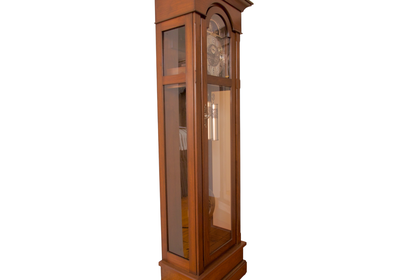
A clock’s profile is so useless! It doesn’t even give you the time of day!
Nor, for that matter, of night.
But front-face, a clock rounds out the facts of time, in its eternal number rut.
Yes, a clock’s cycles are very periodical.
The well-run, non-run-down clock is a very model of regularity!
It’s virtually like clockwork!
Its virtue is clockwork.
You’re really wound-up on the subject.
Momentarily. But we do agree that from the side a clock is just a space-filler, not a time-giver. Yet a person’s profile can serve a purpose, while a clock’s has no purpose.
What purpose is served by the profile of people?
Recognition (as a lead to identity). And in some cases physical attractiveness (as a lead to desire).
Not to mention that, on the face of it, a person is no machine. Whereas a clock often personifies a machine.
Yes. That brings me to a technicality. Namely, that whereas a clock’s hands revolve on its fat round front face, a person’s hands dangle well below that person’s face. Why is that?
Because a person has a more handsome profile?
No, that’s a side-issue.
Oh. The silhouette of this comparison is fully in the dark.
Where I propose to leave it. Which reminds me, that light is needed for both a clock and a person to be seen.
Which would seem to point out a relation between light and time.
Right. But what relation?
I’m not that precise. I’m in the dark.
Oh, I thought your brain went like clockwork.
No. And a perfect clock doesn’t even go like brainwork.
Then where does it go?
Around. With the help of its hands, it gets around, all right.
That’s some feat, for I can only get around with my feet. But that’s due not to my greater nobility, but mobility. As a physical object in itself, a clock makes no motion to be anything but stationary.
Though it stands still in its physical sense, yet its usefulness is in that it’s always moving.
It moves me, or my plight does, to tears.
Though seemingly cold and without animation enough to weep, and devoid of pathetic sentiment, a clock still miraculously conveys a lively sense of the timely.
Yet a clock is merely time’s instrument.
What do you mean, “merely”? That’s a noble service rendered, for which few things are so well endowed to be qualified.
Is man another of time’s instruments?
Yes but battered and broken down. Time does speak through man. But there’s all that emotion involved. Whereas with the clock it’s not emotion, just motion.
And man gets cranky, whereas a clock is cranked.
Man is alarmed, the clock alarming.
Time is alarming.
Through the clock’s ministry.
What is time through man’s ministry?
Wound up to a tragic slowing down, with pathos and poignant feeling. Man is time emotionalized, in the tragic key. The clock is time mechanized, in the key of no feeling.
And what is time, itself?
Time is both man and clock. Time is its instruments.
Is? How can a thing be the things it uses?
Mediums might not merely express content, but be that content.
Then time is two-faced?
Yes: it bears man’s semblance; and the clock’s, as well.
Its features are those of both?
It’s featured principally in both.
What of time as known by the sun?
That’s a different matter, altogether.
Couldn’t you go into it more closely?
My eyes would be burned blind.
But safely can’t your mind pursue it?
That puts things in an altogether astronomical spectrum. Time spoke directly through the clock, as a cool and regular medium. Time spoke directly through man, in a deep ache of sentiment. But the sun!—the sun is too big to be anything’s instrument. Perhaps, in fact, time is the sun’s medium, not the other way around.
The sun expresses itself through time? Funny, I thought it used light for that purpose.
You make light of my purport. Light is but a byproduct. Through time, we get the sun’s message.
Which is hardly a sunny one, for us.
It leaves us on the shady side.
I feel left out in the cold.
The sun is augustly remote.
That’s awful news.
News it’s not, it’s old.
We’re so small that we end when we’re old. The sun is so large, it’s old and endless.
Time is bad news, I’m afraid.
It’s death’s messenger. The sun burns through.

Marvin Cohen (1931–2025) was the author of many novels, plays, and collections of essays, stories, and poems. His shorter work has appeared in over 100 magazines and books, including: Ambit, Antaeus, Assembling, Center Magazine, Cricket Addict’s Archive, Essaying Essays, Extensions, Harper’s Bazaar, Hudson Review, Monk’s Pond, The Nation, National Camp Director’s Guide, New Directions in Prose andPoetry, The New York Times, Plays from the New York Shakespeare Festival, The Pushcart Prize, Quarterly Review of Literature, Salmagundi, Sun and Moon, Transatlantic Review, The Village Voice, Vogue (UK), and Wormwood Review. His work has been performed on radio and theatres in the USA and the UK, including readings at the Poets at the Public Series, featuring, amongst others, Richard Dreyfuss and Wallace Shawn.
Born in Brooklyn, Cohen has described himself as one who has “risen from lower-class background to lower-class foreground.” He studied art at Cooper Union but left college to focus on writing, supporting himself with a series of odd jobs, from mink farmer to merchant seaman. He later taught creative writing at various New York colleges, including The New School, the City College of New York and Adelphi University.
For a long time, Marvin Cohen lived in the Lower East Side, New York City, with his wife Candace.